
Corporate Life Insurance Planning

Corporate Life Insurance Planning: Protect, Reward, and Plan for the Future

Running a business in often means wearing multiple hats—owner, leader, and long-term planner. But have you ever thought about what happens if you or a key person in your company passes away unexpectedly? Or how you might use your corporation to support retirement, reward top talent, or prepare for taxes when transitioning ownership?

Corporate life insurance is one of the most flexible and underused tools available to business owners. It helps protect your company, reduce taxes, and build lasting value—both during your working years and when it’s time to pass the business on.

Let’s look at how business owners are using corporate-owned life insurance to protect their companies and their families while preparing for the future.

brandableContent

Succession Planning: Make Transitions Smooth and Tax-Smart

For many business owners, their company is one of their largest assets. But passing it on—whether to family or a partner—comes with major financial challenges. Life insurance can help.

Funding a Buy-Sell Agreement

If you have a business partner, a buy-sell agreement ensures that if one of you passes away, the other can buy the shares from the deceased’s estate. The problem? That buyout requires cash—often hundreds of thousands, if not millions. Life insurance is a cost-effective way to fund that agreement, so ownership stays in the right hands without putting a strain on the business or the family.

Covering Final Taxes and Capital Gains

When a business owner dies, the Canada Revenue Agency treats it as if they sold their shares—even if they didn’t. This “deemed disposition” creates a tax bill that can surprise even the most prepared families. Life insurance provides a tax-free lump sum that the corporation can use to cover this cost, helping preserve the value of the business and avoid selling off assets under pressure.

Estate Equalization

If you plan to leave the business to one child but want to treat your other children fairly, life insurance can help. The business goes to the child who’s involved, while other beneficiaries receive the life insurance proceeds. It’s a clean, tax-efficient way to avoid family conflict and keep the business whole.

Executive Compensation: Attract and Retain Top Talent

In a competitive hiring environment, offering the right benefits can make all the difference. Life insurance isn’t just about protection—it can be a powerful way to reward and retain your most valuable people.

Executive Compensation Strategies

Life insurance can be part of a compensation package that rewards top performers, especially those who are key to the company’s success. Whether structured as a bonus plan or part of a long-term incentive, this can be a powerful way to align goals and build loyalty.

Retirement Funding

Permanent life insurance policies (like whole life or universal life) build cash value over time. That value grows tax-deferred and can be accessed through policy loans or collateralized lending. Business owners and executives often use this as an additional retirement income stream, especially if they’ve already maxed out RRSP or TFSA contributions.

Tax-Sheltered Wealth Accumulation

The cash value inside a permanent life insurance policy grows on a tax-deferred basis. When a corporation owns the policy, this growth can be especially strategic. It allows the business to use surplus cash to build value in a tax-efficient way, diversify beyond traditional investments, and potentially access funds later with fewer tax consequences. This approach is particularly useful for businesses with retained earnings that would otherwise be subject to higher corporate tax rates.

Business Continuity: Protect What You’ve Built

An unexpected death can do more than cause emotional pain—it can disrupt operations, shake client confidence, and even put the business at risk. Insurance helps ensure your company can keep going.

Key Person Protection

If you or someone else is essential to the day-to-day success of your business, losing that person could be a major financial blow. A life insurance policy on that individual can help the business recover, cover short-term losses, and fund the search for a replacement.

Business Loan Protection

Many lenders require insurance on owners or key executives as a condition of financing. If that person passes away, life insurance ensures the loan is paid off, protecting both the lender and the company’s assets. It can also unlock better lending terms and help avoid personal guarantees.

Charitable Giving Through the Corporation

For business owners looking to give back, corporate life insurance can also be used to support charitable causes. The business can own a policy and name a charity as the beneficiary—creating a lasting impact while offering potential tax benefits.

Bringing It All Together

Corporate life insurance isn’t just about “what if”—it’s about building a stronger, more resilient business and unlocking smart ways to manage wealth inside your company. Whether you’re focused on succession, rewarding your team, or protecting operations, insurance can help you take action today that pays off for years to come.

If you haven’t reviewed your corporate insurance strategy recently, now’s a great time to take a fresh look.

Disclaimer: This article is for informational purposes only and does not constitute financial, legal, or tax advice. Always consult a qualified professional regarding your specific situation. We are not responsible for any actions taken based on this content.

Personal Life Insurance Planning

Personal Life Insurance Planning

When thinking about life insurance, one of the most important steps is figuring out how much coverage you need. Everyone’s situation is unique, but a helpful starting point is understanding your coverage options and thinking about the areas of your life that need protection.

Understanding the Different Types of Life Insurance

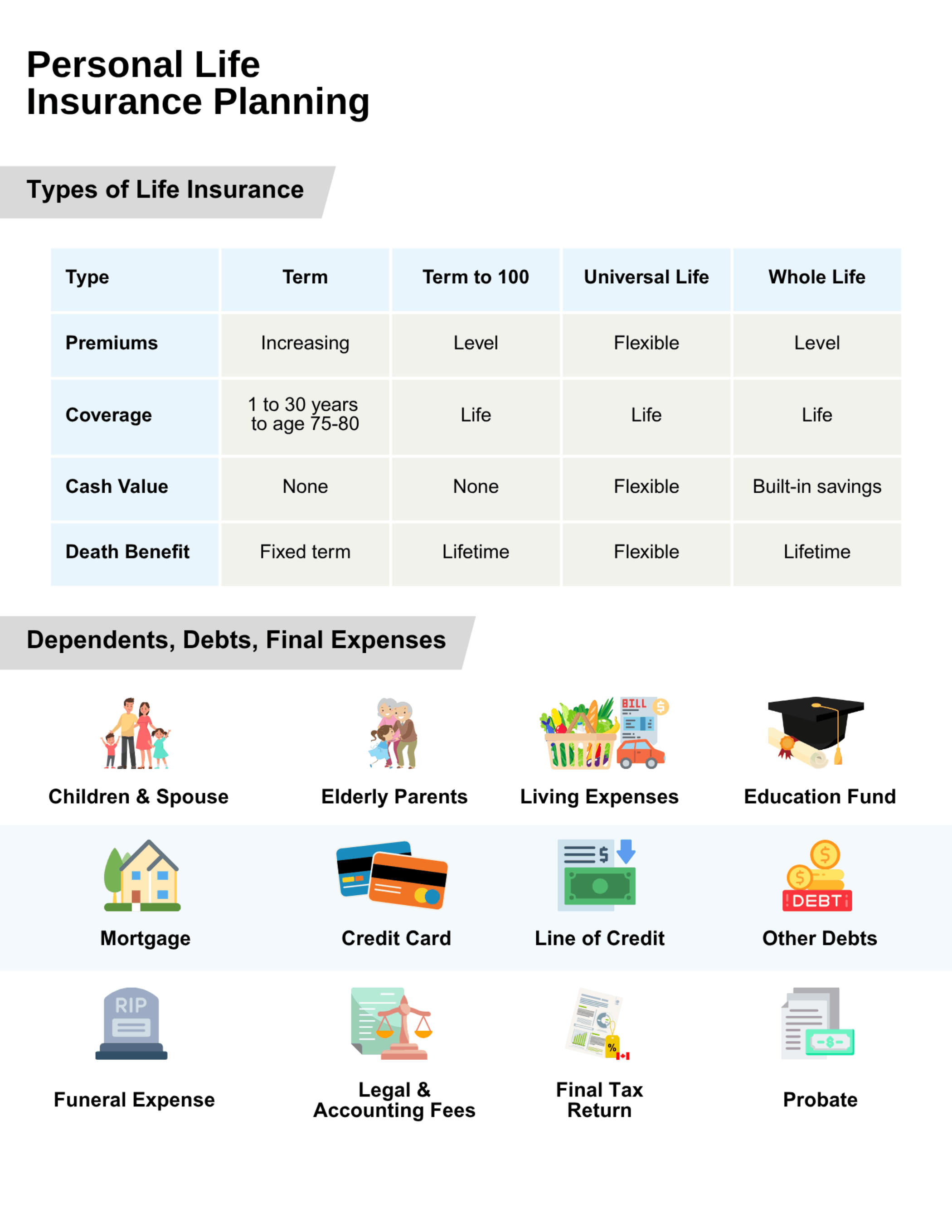
There are four main types of life insurance: Term, Term to 100, Universal Life, and Whole Life. Here’s how they compare:

Term Life Insurance

Term life insurance provides coverage for a specific number of years—typically 10, 20, or 30 years. It offers fixed premiums for the length of the term, and if renewed, premiums will increase based on your age. This type of insurance provides a fixed death benefit during the coverage period and does not build any cash value.

Ideal For: Families with children, people with mortgages or temporary debts

Death Benefit – Common Uses: Income replacement, mortgage protection, child education

Term to 100

Term to 100 offers lifetime coverage with level premiums that are payable until age 100. It is a cost-effective way to get permanent insurance, as it does not accumulate cash value. The policy provides a death benefit as long as premiums are paid.

Ideal For: Those wanting lifetime coverage without investment features

Death Benefit – Common Uses: Final expenses, estate taxes, leaving a small legacy

Universal Life Insurance

Universal life insurance is a flexible form of permanent insurance that includes both a death benefit and a tax-advantaged investment component. You can adjust your premium payments and death benefit within certain limits. The policy’s cash value depends on how much you contribute and the performance of the chosen investments. Funds can be used for investment growth, savings, personal use, and retirement planning.

Ideal For: People who want long-term coverage with savings but require flexibility

Death Benefit Uses: Advanced estate planning, long-term wealth transfer

Cash Value Uses: Emergency funding, retirement planning, education funding, large purchases

Whole Life Insurance

Whole life insurance provides permanent coverage with level premiums and a death benefit. It also builds cash value over time, which you can borrow against, withdraw from, or use to help pay premiums. The cash value may be accessed for emergencies, supplementing retirement income, large purchases, or other long-term needs.

Ideal For: People who want long-term coverage with savings

Death Benefit Uses: Estate planning, legacy, long-term protection

Cash Value Uses: Emergency funding, retirement planning, education funding, large purchases

brandableContent

The need for life insurance

Once you understand your options, the next step is identifying the purpose of the insurance in your life. Most needs fall into three main categories:

Dependents

Whether it’s young children, a spouse, or even elderly parents, many families have one or more people who depend on their income. In these cases, life insurance plays an important role in maintaining the household’s financial stability. It can help pay for groceries, monthly bills, childcare, tuition, or even a car replacement down the road. Think of it as a financial bridge that helps your family maintain their standard of living while they adjust to life without your income.

Debts

Do you have a mortgage? A home equity line of credit? Maybe a personal loan or credit cards with balances that carry over month to month? If something unexpected were to happen, life insurance can ensure those debts don’t fall on your family’s shoulders. A properly structured policy can provide enough to pay off major liabilities, giving your family financial breathing room and the security of keeping their home or lifestyle intact.

Final Expenses

End-of-life costs often catch families off guard. Between funeral expenses, legal and accounting fees, final tax returns, and probate costs, the total can easily reach into the tens of thousands. A life insurance policy can provide immediate funds to help cover these costs without dipping into savings or relying on credit. For many retirees or aging parents, this is one of the biggest reasons to have a policy—even a small one.

Bringing It All Together

Choosing the right life insurance depends on your personal and family goals. Whether you’re protecting your home, your loved ones’ lifestyle, or planning for future expenses, there’s a policy that fits your needs.

If you’re not sure where to start, a good first step is reviewing your current debts, thinking through future costs, and considering who depends on you.

We’re here to help you choose the right coverage—get in touch.

Disclaimer

This article is for informational purposes only and does not constitute financial, legal, or tax advice. Always consult a qualified professional regarding your specific situation. We are not responsible for any actions taken based on this content.

How To Use Insurance To Provide Your Family With Financial Protection

How To Use Insurance To Provide Your Family With Financial Protection

The best way to provide your family with financial protection is with solid insurance planning. These three types of insurance will ensure your family has the financial resources they need if you die, are injured, or become ill:

  • Life insurance.
  • Critical illness insurance.
  • Disability insurance.

Life Insurance

Life insurance is an inexpensive way to ensure your family will have access to a tax-free lump sum payment after your death. Whether you want to give your grandchildren a helping hand getting started in life or provide financial resources for a stay-at-home parent, life insurance can be a great way to do it!

You have two main options when it comes to life insurance – term insurance and permanent life insurance.

With term insurance, you’ve got life insurance coverage for a set period (for example, five years). Premiums for term insurance are lower than for permanent life insurance, but they will rise as you age or your health changes.

With permanent life insurance, you’ve got lifetime coverage. You’ll pay more in premiums at first, but the cost will be less overall than if you buy term insurance for your entire life. Some permanent life insurance policies also allow you to contribute money beyond your premiums, where it can grow tax-free.

Not sure which type is best for you? We can help you figure this out!

Critical Illness Insurance

With critical illness insurance, you will be eligible for a tax-free lump sum of money if you’re diagnosed with a significant illness such as cancer or a stroke. While anyone can benefit from this insurance, it’s essential for self-employed people who don’t have employee benefits to help tide them over while recovering or receiving treatment.

You can spend the lump sum any way you want, including paying off your mortgage, paying for treatment not covered by provincial health care, or putting aside money for your children’s future.

Depending on the type of critical illness policy you select, you may be able to get a “return of premium” option, which means your premiums will be returned to you if you never make a claim. We can explain how to option works and what coverage we think is best for you.

Disability Insurance

Most people assume that they’ll never become disabled. But the stark reality is that 1 in 5 Canadians are considered to be living with a disability. If you couldn’t work anymore because you became disabled, this could have a disastrous impact on your family’s financial stability – especially if you’re self-employed.

With disability insurance, you’ve got financial protection to ensure you can pay your bills and maintain your family’s standard of living. We can explain how to minimize the cost of your premiums while still getting the coverage you need.

Protect Your Family

Book a meeting with us today to get started with insurance planning.

How To Use Insurance To Provide Your Family With Financial Protection

How To Use Insurance To Provide Your Family With Financial Protection

The best way to provide your family with financial protection is with solid insurance planning. These three types of insurance will ensure your family has the financial resources they need if you die, are injured, or become ill:

  • Life insurance.
  • Critical illness insurance.
  • Disability insurance.

Life Insurance

Life insurance is an inexpensive way to ensure your family will have access to a tax-free lump sum payment after your death. Whether you want to give your grandchildren a helping hand getting started in life or provide financial resources for a stay-at-home parent, life insurance can be a great way to do it!

You have two main options when it comes to life insurance – term insurance and permanent life insurance.

With term insurance, you’ve got life insurance coverage for a set period (for example, five years). Premiums for term insurance are lower than for permanent life insurance, but they will rise as you age or your health changes.

With permanent life insurance, you’ve got lifetime coverage. You’ll pay more in premiums at first, but the cost will be less overall than if you buy term insurance for your entire life. Some permanent life insurance policies also allow you to contribute money beyond your premiums, where it can grow tax-free.

Not sure which type is best for you? We can help you figure this out!

Critical Illness Insurance

With critical illness insurance, you will be eligible for a tax-free lump sum of money if you’re diagnosed with a significant illness such as cancer or a stroke. While anyone can benefit from this insurance, it’s essential for self-employed people who don’t have employee benefits to help tide them over while recovering or receiving treatment.

You can spend the lump sum any way you want, including paying off your mortgage, paying for treatment not covered by provincial health care, or putting aside money for your children’s future.

Depending on the type of critical illness policy you select, you may be able to get a “return of premium” option, which means your premiums will be returned to you if you never make a claim. We can explain how to option works and what coverage we think is best for you.

Disability Insurance

Most people assume that they’ll never become disabled. But the stark reality is that 1 in 5 Canadians are considered to be living with a disability. If you couldn’t work anymore because you became disabled, this could have a disastrous impact on your family’s financial stability – especially if you’re self-employed.

With disability insurance, you’ve got financial protection to ensure you can pay your bills and maintain your family’s standard of living. We can explain how to minimize the cost of your premiums while still getting the coverage you need.

Protect Your Family

Book a meeting with us today to get started with insurance planning.

Insurance Planning for Incorporated Professionals

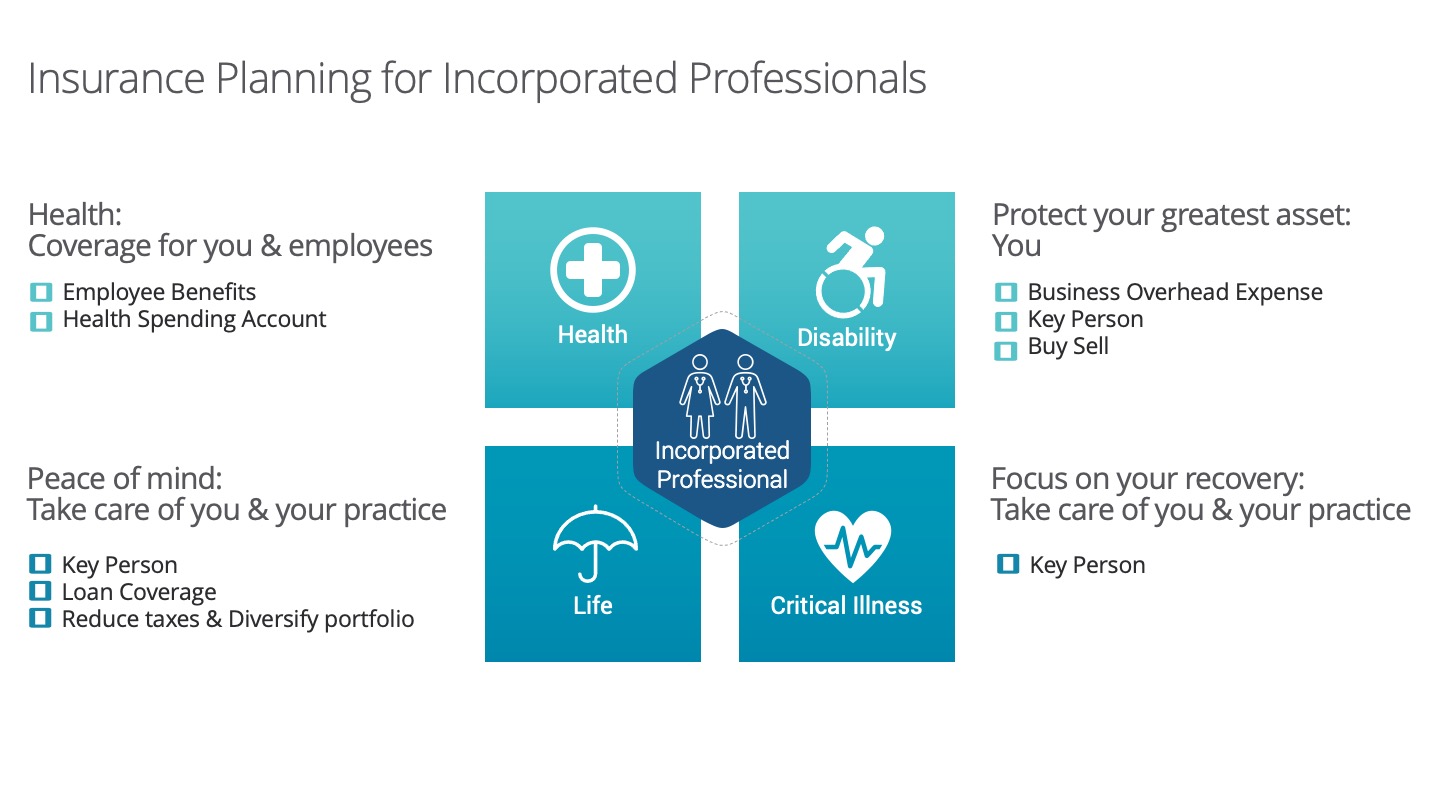
For incorporated professionals, making sure your practice is financially protected can be overwhelming. Incorporated professionals face a unique set of challenges when it comes to managing risk. Insurance can play an important role when it comes to reducing the financial impact on your practice in the case of uncontrollable events such as disability, or critical illness. This infographic and article address the importance of corporate insurance.

The 4 areas of insurance a incorporated professional should take care of are: 

  • Health 

  • Disability 

  • Critical Illness 

  • Life

Health: We are fortunate in Canada, where the healthcare system pays for basic healthcare services for Canadian citizens and permanent residents. However, not everything healthcare related is covered, in reality, 30% of our health costs* are paid for out of pocket or through private insurance such as prescription medication, dental, prescription glasses, physiotherapy, etc.

For incorporated professionals, offering employee health benefits make smart business sense because health benefits can form part of a compensation package and can help retain key employees and attract new talent.

For incorporated professionals that are looking to provide alternative health plans in a cost effective manner, you may want to consider a health spending account.

Disability: Most people spend money on protecting their home and car, but many overlook protecting their greatest asset: their ability to earn income. Unfortunately one in three people on average will be disabled for 90 days or more at least once before the age of 65.

Consider the financial impact this would have on your practice if you or a key employee were to suffer from an injury or illness. Disability insurance can provide a monthly income to help keep your practice running.

Business overhead expense insurance can provide monthly reimbursement of expenses during total disability such as rent for commercial space, utilities, employee salaries and benefits, equipment leasing costs, accounting fees, insurance premiums for property and liability, etc.

Key person disability insurance can be used to provide monthly funds for you or key employee while they’re disabled and protect the business from lost revenue while your business finds and trains an appropriate replacement.

Critical Illness: For a lot of us, the idea of experiencing a critical illness such as a heart attack, stroke or cancer can seem unlikely, but almost 3 in 4 (73%) working Canadians know someone who experience a serious illness. Sadly, this can have serious consequences on you, your family and business, with Critical Illness insurance, it provides a lump sum payment so you can focus on your recovery.

Key person critical illness insurance can be used to provide funds to the practice so it can supplement income during time away, cover debt repayment, salary for key employees or fixed overhead expenses.

Buy sell critical illness insurance can provide you with a lump sum payment if your business partner or shareholder were to suffer from a critical illness. These funds can be used to purchase the shares of the partner, fund a buy sell agreement and reassure creditors and suppliers.

Life: For an incorporated professional, not only do your employees depend on you for financial support but your loved ones do too. Life insurance is important because it can protect your practice and also be another form of investment for excess funds.

Key person life insurance can be used to provide a lump sum payment to the practice on death of the insured so it can keep the business going until you an appropriate replacement is found. It can also be used to retain loyal employees by supplying a retirement fund inside the insurance policy.

Loan coverage life insurance can help cover off any outstanding business loans and debts.

Reduce taxes & diversify your portfolio, often life insurance is viewed only as protection, however with permanent life insurance, there is an option to deposit excess funds not needed for operations to provide for tax-free growth (within government limits) to diversify your portfolio and reduce taxes on passive investments.  

Talk to us to make sure you and your practice are protected.

When and Why You Should Conduct an Insurance Audit

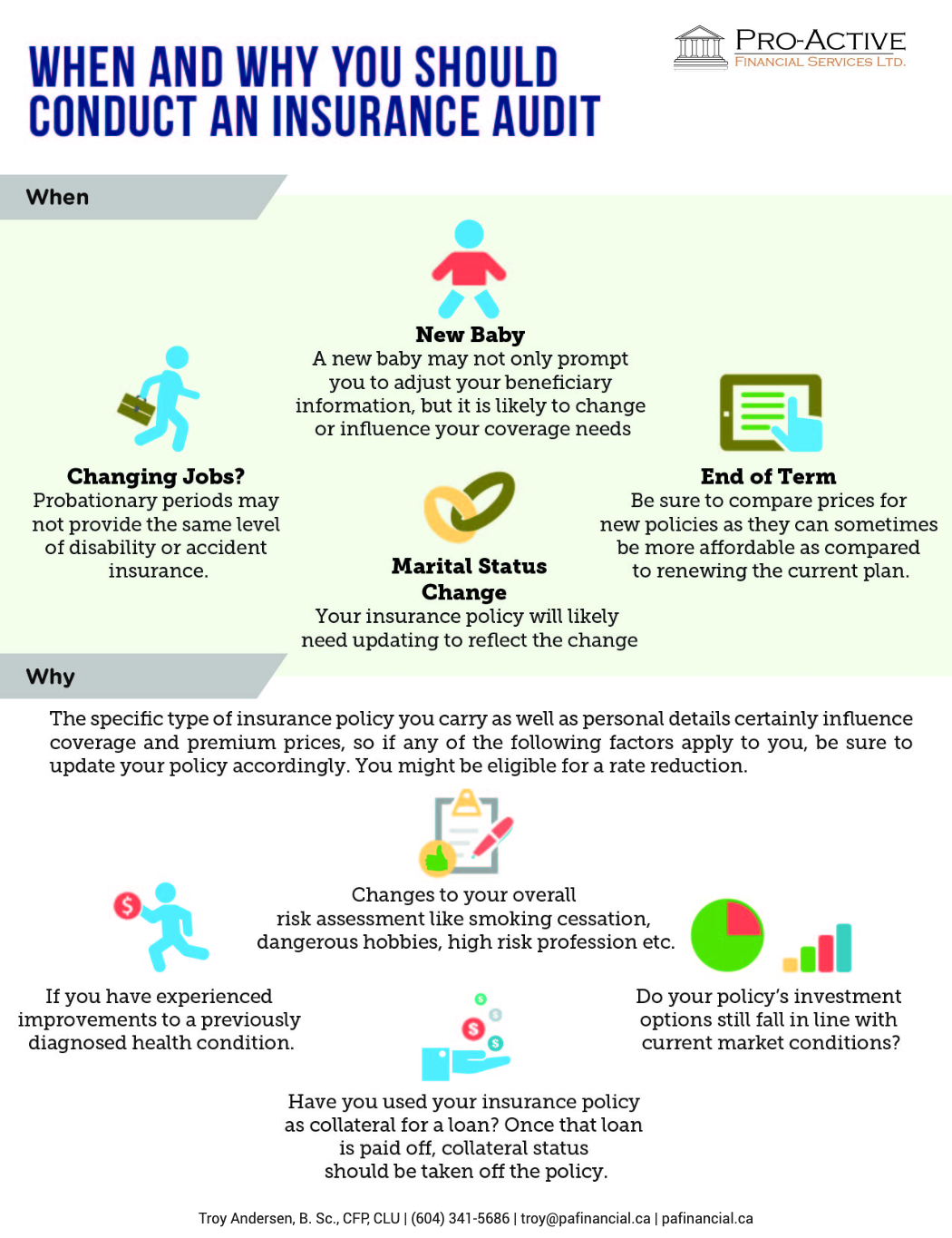
As our lives grow and change with variable circumstances, new additions, and job transitions, our needs for insurance will also evolve. Additionally, economic fluctuations and external circumstances that influence your insurance policy will need frequent re-evaluation to ensure that you are making the most appropriate and financially favorable decisions. Perhaps you aren’t sure whether you should conduct an insurance audit or not. The following scenarios are usually a good indication that you should thoroughly assess and review your current policy contract: 

  • Bringing new life into your family? A new baby may not only prompt you to adjust your beneficiary information, but it is likely to change or influence your coverage needs.

  • Changing jobs? Probationary periods may not provide the same level of disability or accident insurance.

  • Is your policy nearing the end of its term? Be sure to compare prices for new policies as they can sometimes be more affordable as compared to renewing the current plan.

  • Has your marital status changed? Your insurance policy will likely need updating to reflect such.

The specific type of insurance policy you carry as well as personal details certainly influence coverage and premium prices, so if any of the following factors apply to you, be sure to update your policy accordingly. You might be eligible for a rate reduction. 

  • Changes to your overall risk assessment like smoking cessation, dangerous hobbies, high risk profession etc.

  • If you have experienced improvements to a previously diagnosed health condition.

  • Do your policy’s investment options still fall in line with current market conditions?

  • Have you used your insurance policy as collateral for a loan? Once that loan is paid off, collateral status should be taken off the policy.

Insurance policies generated for business purposes should also be regularly reviewed to make sure the policy still offers adequate coverage to meet the needs of the company and includes the appropriate beneficiary information. With life happening so quickly, it can be easy to forget about keeping insurance policies up to date, however, major changes can have a profound impact on coverage and premiums. Be sure to conduct insurance audits often to ensure your policies are still meeting your needs. 

Contact us to see how we can help. 

Life Insurance after 60- is it necessary?

You may have had life insurance for as long as you can remember. You wanted to make sure that your family would be taken care of and be able to pay their bills if anything happened to you.

But now that you’re older and your children are grown – and hopefully your mortgage is paid off – you may not feel you still need life insurance. This could be a valid assumption; however, there are some circumstances under which it may still make sense for you to have life insurance. They are:

  • You still have substantial debt.

  • You have dependent children or grandchildren.

  • You want to leave a financial legacy.

You still have substantial debt

No one likes the thought of leaving their loved ones to pay their debts if they die. If, however, someone has co-signed a loan with you – for example, for a mortgage or a car – and you die, then they will be on the hook for the entire amount.

If you have life insurance and name your co-signer as the beneficiary, this will help relieve any financial burden your death could cause them.

You have dependent children or grandchildren

If you have children who are still dependent on you because they have a mental or physical disability, life insurance can be an excellent way to ensure they will still have access to funds after you die.  Lifelong care can be expensive, and a life insurance benefit will go a long way to helping fund it.

You may have grandchildren you are caring for or that you are not responsible for but want to leave money they can use towards higher
education.  A life insurance payout can be a great way to help a grandchild get a good start in life without having to go into debt.

You want to leave a financial legacy

You may not have dependent children or grandchildren but still want to leave them something when you die. Life insurance can be a great way to do this without cutting back on your spending during your lifetime.

Life insurance can also help make sure that you have something to leave everyone in your will. If you have a family cottage, it can
be complicated to leave it to more than one person or family. Life insurance gives you the option to leave one person or family the cottage and another person or family the cash equivalent.

We can help you!

If you’re unsure whether or not it still makes sense to have life insurance after the age of 60, we’d be happy to sit down with you and talk through your options. Give us a call or email us today!

Why Should I Review My Life Insurance?

Why Should I Review My Life Insurance?

It’s great that you’ve taken the critical step of buying life insurance. But have you reviewed it recently to make sure that your policy is still suitable for you? It’s important to review your life insurance policy annually to check that your policy is up-to-date and see if you require any additional coverage.

There are several reasons you may need to change your life insurance policy. We’ve listed them below.

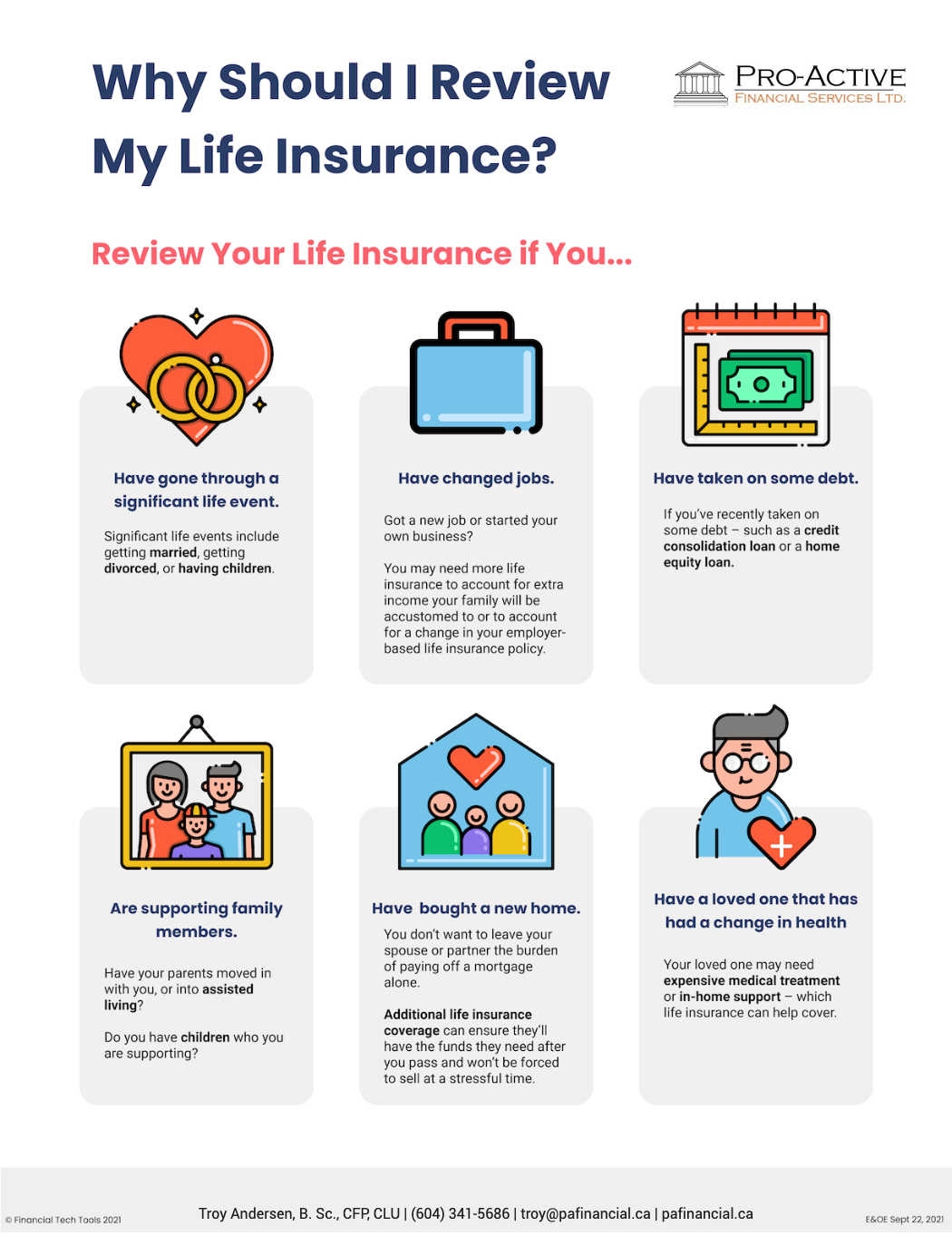
You’ve gone through a significant life event

You may have gone through a significant life event – such as getting married or divorced or having a child – in the past year. In this case, it’s important to consider changing your beneficiaries to make sure that your life insurance proceeds are distributed appropriately.

If you don’t update your beneficiaries, a previously named beneficiary could still be legally entitled to the money you want other people to receive.

You’ve changed jobs

Congratulations – you’ve got a new job or even started your own business! If you’ve started a new job, you may need more life insurance to account for extra income your family will be accustomed to or to account for a change in your employer-based life insurance policy.

If you’ve started a new business, you’ll likely need additional life insurance to help cover debts you may have taken on to start your new business. Plus, since you’re self-employed, you won’t have any employer-based life insurance anymore.

You’ve taken on some debt

If you’ve recently taken on some debt – such as a credit consolidation loan or a home equity loan – more life insurance may be a good idea. Additional life insurance can provide your loved ones with some much-needed extra income to help pay off debt or even pay for basic living expenses if you die.

You’re supporting family members

If your parents have moved in with you or have moved into assisted living, they may require financial support. Additional life insurance can help pay for this increased financial load.

If you have children ready for college or university, they’ll still need financial support from you. You can help secure their financial future with a life insurance policy that will help cover tuition costs.

You’ve bought a new home

You don’t want to leave your spouse or partner the burden of paying off a mortgage alone. Additional life insurance coverage can ensure they’ll have the funds they need after you pass and won’t be forced to sell at a stressful time.

A loved one has a change in health

If a loved one has recently had a change in their health or a significant medical diagnosis, then it’s essential to review your life insurance coverage. Your loved one may need expensive medical treatment or in-home support – which life insurance can help cover if you die.

If you have any questions about your life insurance coverage or want to make any changes, give us a call!

When should I buy life insurance?

When should I buy life insurance?

Life insurance can benefit you no matter what stage of life you’re at. It’s never too soon or too late to buy life insurance. Not only will it give you peace of mind, but it will also provide your loved ones with financial support after you die.

Types of life insurance

There are two main types of life insurance:

  1. Term life provides temporary coverage for a set amount of time (for example, 10, 15, or 20 years).

  2. Permanent coverage is life insurance that never expires.

Term life is generally cheaper as it is only good for a set amount of time. Permanent insurance will cost you more in the short run but may work out less expensive in the long run as your premiums do not tend to increase as you age.

Life insurance in your 20s

In your 20s, you may feel like you’re immortal and have lots of other things you want to spend your money on. But you also likely have responsibilities – such as student loans your parents may have co-signed for or a mortgage with your partner. If something happened to you, your loved ones would be left alone to pay for that debt. Life insurance could help fill this financial gap.

Also, another great reason to get life insurance in your 20s is that it’s very affordable! You will have a low insurance premium because you are considered low risk.

Life insurance in your 30s

By the time you’re in your 30s, you may have several financial responsibilities – including a mortgage and children. If you’ve only had term insurance up to this point, you may want to consider converting it to permanent to help give yourself lifelong protection.

Even if you have life insurance through your workplace, you may want to buy additional life insurance. Separate life insurance can help cover you if you lose your job or lock-in rates while you are relatively young and healthy.

Life insurance in your 40s, 50s, 60s and beyond

At this stage in your life, you may still have a mortgage or dependent children. You may have even bought a cottage or a vacation property. No matter your financial responsibilities, if your estate doesn’t have enough cash to cover them, it’s essential to have life insurance still.

Now is an excellent time to lock in permanent insurance. However, if you find the premiums too high or know you only need life insurance for a set amount of time, term life may still work for you.

Your next steps

Now you know about the two main types of life insurance and why it’s crucial to have it, no matter what age you are. If you’re not sure where to go from here, contact your insurance advisor or us – we can help you figure out your next steps!