What You Need to Know About RRIFs

What You Need to Know About RRIFs: Turning Your RRSP Into Retirement Income

As retirement approaches, many Canadians start wondering: what happens to all the savings they’ve been building in their RRSP? The good news is, your RRSP doesn’t just stop working for you when you turn 71. Instead, it can be converted into a Registered Retirement Income Fund (RRIF)—a flexible way to draw steady income while keeping your investments working.

What is an RRIF, and how is it different from an RRSP?

An RRIF is essentially the next stage of your RRSP. While an RRSP is designed for growing your retirement savings, an RRIF is designed for drawing income from them. You’re required to convert your RRSP into an RRIF (or an annuity) by the end of the year you turn 71, though you can convert earlier if it suits your needs.

Unlike an RRSP, you can’t contribute new money to an RRIF, and you’re required to withdraw at least a minimum amount each year. The investments inside your RRIF—like GICs, stocks, bonds, mutual funds—can continue to grow tax-deferred, but your withdrawals are taxable as income.

How do you transfer funds into an RRIF and what can you hold in it?

Converting your RRSP to an RRIF is straightforward. You open an RRIF account at your financial institution and transfer all or part of your RRSP into it. There are no taxes payable on this transfer itself.

Your RRIF can hold the same types of investments you had in your RRSP. That means you can continue to hold stocks, bonds, GICs, mutual funds, ETFs, and even cash. Many people simply carry their RRSP portfolio over to the RRIF unchanged, but it’s also an opportunity to adjust your investments to align with your income needs and risk comfort level.

Do you have to convert all your RRSPs at once?

If you have more than one RRSP account, you don’t have to convert all of them into an RRIF at the same time. You can convert just one account, a portion of your savings, or all of them—whatever works best for your situation.

Some people convert one RRSP early to supplement income while leaving the rest to grow. Others choose to convert all their accounts into one or more RRIFs for simplicity. Just keep in mind that by December 31 of the year you turn 71, all RRSP funds must be converted—whether into RRIFs, annuities, or withdrawn as cash.

You can also have more than one RRIF if you prefer to keep different investments or strategies separate. Each RRIF has its own minimum withdrawal based on its balance at the start of each year.
brandableContent

When should you convert your RRSP?

You must convert your RRSP into an RRIF no later than December 31 of the year you turn 71, but you don’t have to wait until then. Some Canadians choose to convert earlier, especially if they retire before age 71 and want to start drawing from their savings. Others may convert a portion of their RRSP to an RRIF early to smooth out taxable income over several years or to supplement other income sources.

Can you convert before age 71?

Yes. You can convert your RRSP to an RRIF at any age, as long as you’re ready to begin taking taxable withdrawals. For example, someone retiring at age 60 may decide to convert part of their RRSP to an RRIF and leave the rest in the RRSP to continue growing.

Converting your RRSP to a RRIF at retirement

By the end of the year you turn 71, you can no longer contribute to an RRSP — and you must convert it into an income stream. The most common way to do this is by transferring it into a Registered Retirement Income Fund (RRIF).

A RRIF keeps your investments tax-sheltered, but you’re required to withdraw a minimum amount each year, which is taxable. The minimum starts small and increases as you age.

Alternatively, you can purchase an annuity to guarantee income for life, but a RRIF gives you more flexibility to manage your investments and withdrawals.

Understanding RRIF Minimum Withdrawals

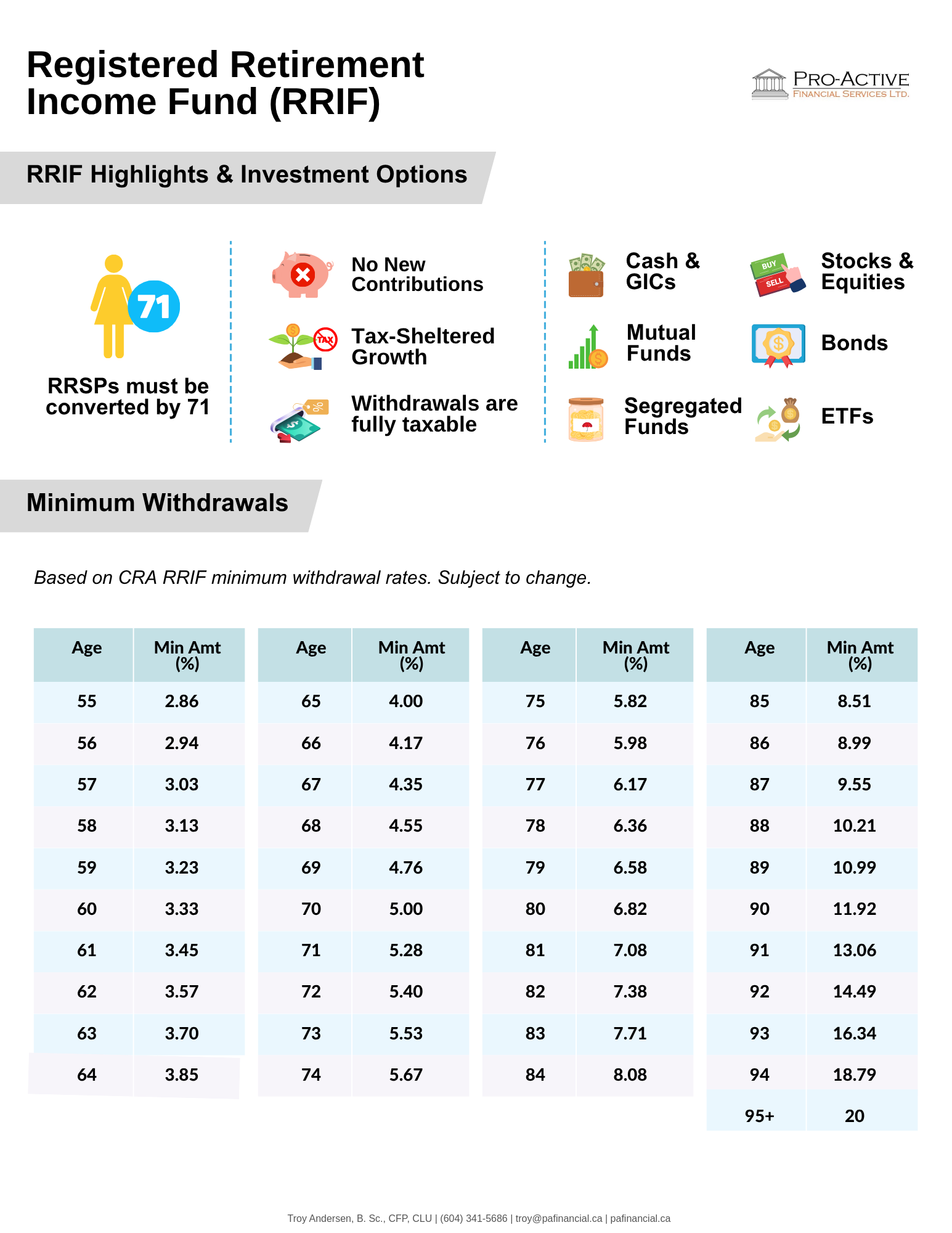
One of the key rules with an RRIF is that you must withdraw at least a minimum amount each year, starting the year after you open the account. This minimum is calculated as a percentage of the total value of your RRIF on January 1 each year, and the percentage increases as you age.

For example, if you are 71, the minimum is about 5.28% of your RRIF balance. At 80, it’s about 6.82%, and it continues to rise each year. You can always withdraw more than the minimum if you need to, but you cannot withdraw less.

If you’d like to lower your required withdrawals, you can choose to have the minimum based on your younger spouse’s age when you set up the RRIF. This option is helpful if you want to keep more money invested and reduce taxable income in the early years.

It’s important to plan these withdrawals carefully, especially if you don’t need all the income right away. Any funds you withdraw that you don’t spend can be invested in a TFSA or a non-registered account, depending on your available contribution room and tax strategy.

What if you don’t need the money immediately?

Even if you don’t need the income right now, you still have to withdraw at least the minimum each year. There’s no option to skip withdrawals altogether, but you can reinvest the money in a non-registered account or a TFSA if you have contribution room, allowing it to continue growing tax-efficiently.

How are RRIF withdrawals taxed?

Withdrawals from an RRIF are considered taxable income in the year you take them. Your financial institution will issue a T4RIF slip, which shows the taxable amount (Box 16) and any tax withheld. You report the taxable amount on line 13000 of your personal tax return under “Other income.” Any tax already withheld is credited when you file.

It’s a good idea to plan your RRIF withdrawals alongside other income sources (like CPP or OAS) to help manage your overall tax bill and avoid moving into a higher tax bracket.

What happens at death? Choosing a beneficiary and successor annuitant

When you open an RRIF, you can name a beneficiary or a successor annuitant. If you name your spouse as a successor annuitant, they can take over the RRIF without tax consequences, continuing to receive income from it. If you name your spouse or a financially dependent child as a beneficiary, the RRIF can be transferred to them with reduced tax consequences. If no beneficiary is named, the full value of the RRIF is included as income on your final tax return.

Naming the right person and understanding the tax implications is an important step in ensuring your retirement savings benefit your loved ones as you intended.

Your RRIF is more than just a requirement after age 71—it’s a flexible and valuable way to turn your hard-earned savings into a sustainable income stream. Planning how and when to convert your RRSP, understanding your minimum withdrawal requirements, and choosing a beneficiary thoughtfully can help you get the most out of your retirement savings.

If you’d like help reviewing your options, reach out—we’d be happy to guide you through the process.

Disclaimer: This article is for informational purposes only and does not constitute financial, legal, or tax advice. Always consult a qualified professional regarding your specific situation. We are not responsible for any actions taken based on this content.

Sources:

Government of Canada. Registered Retirement Income Fund: https://www.canada.ca/en/revenue-agency/services/tax/businesses/topics/completing-slips-summaries/t4rsp-t4rif-information-returns/payments/chart-prescribed-factors.html

Tax Tips. Registered Retirement Income Fund: https://www.taxtips.ca/rrsp/rrif-minimum-withdrawal-factors.htm

OAS Clawback 2025: What Retirees Need to Know About the Recovery Tax

OAS Clawback 2025

If you’ve worked hard to build your retirement income, the last thing you want is to see your government benefits clawed back. Yet for many Canadians, the Old Age Security (OAS) recovery tax—commonly called the OAS clawback—can quietly reduce this valuable benefit.

Here’s how the recovery tax works in 2025, what happens if you delay OAS to age 70, and the strategies we use to help our clients minimize or avoid the clawback.

What is the OAS Recovery Tax?

OAS is a monthly benefit available to most Canadians aged 65 and older. However, once your income exceeds a certain level, the government recovers part or all of your OAS through the recovery tax.

This is calculated based on Line 23400 of your tax return—net income before adjustments. In 2025, the clawback begins when your income exceeds $93,454. For every dollar above that amount, you must repay 15 cents of your OAS.

If your income reaches approximately $151,668 (age 65–74) or $157,490 (age 75+), you could lose your entire OAS benefit for the year.

How Much is the OAS Benefit in 2025?

From July through September 2025, the maximum monthly OAS payment is:

  • $734.95 for individuals aged 65–74 (about $8,820 annually)

  • $808.45 for individuals aged 75+ (reflecting a 10% enhancement introduced in 2022)

These amounts are indexed quarterly to inflation and are subject to clawback if your Line 23400 income exceeds the threshold.

What Happens if You Delay OAS Until 70?

You can choose to delay receiving OAS up to age 70, increasing your monthly benefit by 0.6% for each month deferred—a total boost of up to 36% if you wait the full five years.

While a higher payment may sound appealing, it can also lead to larger OAS repayments if your income—including CPP, investment returns, or pension income—exceeds the recovery threshold. Delaying OAS often makes sense for healthy individuals who expect to live into their late 80s or beyond and have lower taxable income during the deferral period.

How the OAS Recovery Tax Works

Example: Alan is 68 and receives the maximum OAS: $8,820 annually. In 2025, the clawback threshold begins at $93,454. Alan’s line 23400 income is $100,000—that’s $6,546 over the clawback threshold. As a result, he must repay: $6,546 × 15% = $981.90

This leaves Alan with $7,838.10 in OAS benefits for the year. If he earns more, the repayment increases proportionally. Once Alan’s income reaches around $151,668 (if aged 65–74) or $157,490 (if aged 75+), his entire OAS would be clawed back.

The recovery tax calculation is automatic and appears on your Notice of Assessment each spring, adjusting your OAS payments for the following July–June period.

brandableContent

Strategies to Reduce or Avoid the OAS Clawback

The good news? There are practical ways to lower your Line 23400 income without compromising your lifestyle. Here are some of the strategies we use to help our clients keep more of their benefits:

Use a TFSA for Retirement Income

Withdrawals from a Tax-Free Savings Account (TFSA) don’t count toward Line 23400. Drawing income from a TFSA instead of taxable accounts can help preserve your OAS and reduce your tax burden.

Manage RRIF Withdrawals

RRIF withdrawals are fully taxable and included in Line 23400. If you don’t need the full minimum withdrawal, we may recommend delaying full RRSP-to-RRIF conversion or converting just part each year starting at age 65. This can help smooth your income and avoid large spikes.

Delay OAS or Split Withdrawals Over Time

If you’re planning to delay OAS, we’ll help ensure you’re not unintentionally stacking income in the deferral years. Likewise, we can help you spread RRSP-to-RRIF conversions over several years to avoid unnecessary spikes in income.

Pension Income Splitting

If you’re married or in a common-law relationship, you can split up to 50% of eligible pension income with your spouse. This reduces your taxable income and can keep you below the clawback threshold—especially effective when one spouse earns significantly less.

Choose Tax-Efficient Investments

Not all investment income is taxed equally:

  • Capital gains: 50% taxable; more clawback-friendly

  • Eligible dividends: grossed up for Line 23400 purposes, potentially triggering more clawback despite the tax credit

  • Interest income: fully taxable and the least efficient for minimizing clawback

We can help structure your investments to be as clawback-friendly as possible.

Donate Securities Instead of Cash

Donating appreciated publicly traded securities directly to a registered charity eliminates the capital gains tax, reduces net income, and supports a cause—all while lowering recovery tax exposure.

Defer Large Income Events

Selling a property, realizing a large capital gain, or cashing a pension lump sum can push you into full clawback territory. If possible, we can help you plan these events to spread them over several years or delay them to a lower-income year.

Consider Leveraged Investing

Some higher-net-worth clients use leveraged investment strategies—borrowing to invest in tax-efficient, capital-gains-producing assets. Interest may be deductible, and investment income can be structured to reduce Line 23400. This is a high-risk strategy and something we’ll discuss carefully if appropriate.

Talk to Your Financial Advisor

Everyone’s income, retirement timing, and tax situation are unique. That’s why we take the time to understand your goals, project your Line 23400 income, explore different scenarios, and build a personalized strategy designed to minimize the recovery tax while keeping your lifestyle in mind.

The OAS recovery tax can quietly chip away at your retirement income—but it doesn’t have to. With the right guidance and a plan tailored to you, it’s possible to keep more of what you’ve worked so hard to earn.

If you’re already retired or approaching retirement, now is the perfect time to sit down and talk. Together, we’ll review where you stand, explore your options, and build a strategy that keeps more of your income working for you. We’re here to help you make the most of your retirement—let’s get started.

Disclaimer: This article is for informational purposes only and does not constitute financial, legal, or tax advice. Always consult a qualified professional regarding your specific situation. We are not responsible for any actions taken based on this content.

Sources: Old Age Security Payment Amount – Government of Canada: https://www.canada.ca/en/services/benefits/publicpensions/old-age-security.html

Old Age Security Pension Recovery Tax– Government of Canada: https://www.canada.ca/en/services/benefits/publicpensions/old-age-security/recovery-tax.html

Tax Tips for Filing Your 2024 Income Tax Return

The deadline for filing your 2024 income tax return is April 30, 2025. Stay informed about the latest tax changes and benefits available to maximize your savings and ensure compliance. This guide outlines the key updates and important deductions and credits separated into sections for Individuals and Families, and Self-Employed Individuals.

For Individuals and Families

Alternative Minimum Tax (AMT)

  • Increased minimum tax rate and basic exemption threshold.

  • Modified calculation for adjusted taxable income affecting foreign tax credits and minimum tax carryovers.

  • Limited value on most non-refundable tax credits.

Canada Pension Plan (CPP) Enhancement

• The standard CPP contribution rate remains at 5.95% for both employees and employers on earnings up to $68,500 (the Year’s Maximum Pensionable Earnings or YMPE) in 2024.

• Additionally, employees and employers each contribute an extra 4% on earnings between the YMPE ($68,500) and the Year’s Additional Maximum Pensionable Earnings (YAMPE) of $73,200 in 2024.

Home Buyers’ Plan (HBP)

  • Withdrawal limit increased from $35,000 to $60,000 after April 16, 2024, with temporary repayment relief available.

Volunteer Firefighters and Search and Rescue Volunteers

  • Amounts increased from $3,000 to $6,000 for eligible individuals completing at least 200 hours of combined volunteer service.

Basic Personal Amount (BPA)

• For 2024, the Basic Personal Amount (BPA) has increased to $15,705 for taxpayers with net income up to $173,205.

• For taxpayers with net incomes above this amount, the BPA is gradually reduced, reaching a minimum of $14,138 at incomes of $235,675 or higher.

Short-term Rentals

  • Expenses related to non-compliant short-term rentals are no longer deductible after January 1, 2024.

Popular Tax Credits and Deductions

Canada Training Credit (CTC) Eligible taxpayers aged 26 to 65 can claim this refundable tax credit to cover a portion of eligible tuition and fees for training or courses to enhance their skills.

Canada Caregiver Credit (CCC) This non-refundable tax credit supports individuals caring for family members or dependents with a physical or mental impairment. The amount varies based on the dependent’s relationship, net income, and circumstances.

Child Care Expenses Child care expenses, such as daycare, nursery schools, day camps, and boarding schools, are deductible if incurred to enable a parent or guardian to work, pursue education, or conduct research.

Disability Tax Credit (DTC) The DTC provides a non-refundable tax credit for individuals with disabilities or their caregivers to reduce the amount of income tax payable. Applicants must have a certified disability lasting at least 12 months.

Moving Expenses Deductible moving expenses include transportation and storage costs, travel expenses, temporary living costs, and incidental expenses incurred when relocating at least 40 kilometers closer to a new work location, educational institution, or business location.

Interest Paid on Student Loans Interest paid on eligible student loans can be claimed as a non-refundable tax credit. The loans must be under federal, provincial, or territorial student loan programs.

Donations and Gifts Donations made to registered charities or other qualified organizations qualify for non-refundable federal and provincial tax credits. Typically, you can claim eligible amounts up to 75% of your net income.

GST/HST Credit The GST/HST credit is a quarterly refundable payment designed to offset the impact of sales tax on low to moderate-income individuals and families. Eligibility is automatically assessed based on your annual tax return.

For Self-Employed Individuals

CPP Contributions

  • Enhanced CPP contribution rate for self-employed individuals.

Filing and Payment Deadlines

  • Tax Return Deadline: June 16, 2025 (June 15 is Sunday).

  • Balance due must be paid by April 30, 2025.

Reporting Business Income

  • Report income on a calendar-year basis for sole proprietorships and partnerships.

Digital Platform Operators

  • New reporting rules requiring platform operators to collect and report seller information.

Mineral Exploration Tax Credit

  • Eligibility extended for flow-through share agreements signed before April 2025.

Need Assistance?

If you’re unsure about your eligibility for specific credits or deductions, reach out to your tax consultant or tax advisor for personalized guidance. They can help you optimize your tax return, maximize your savings, and ensure compliance with CRA regulations.

Sources

Group Retirement Benefits

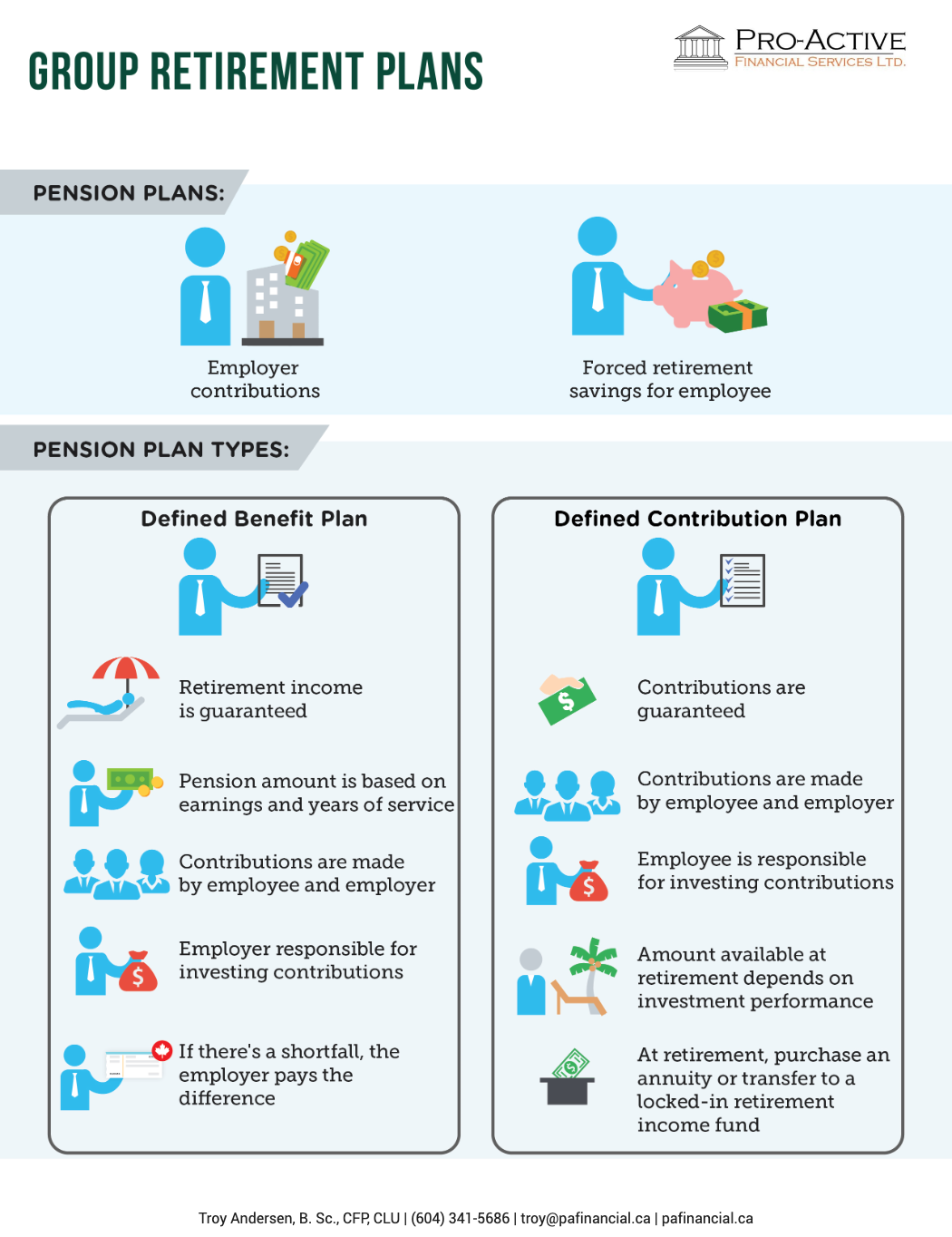
Working at an organization that offers a pension plan is one of the greatest financial advantages a Canadian can enjoy. Pension plans are designed to provide retirement income and help employees reach their retirement goals and for business owners- help retain key employees.

Pension plans can offer:

  • Employer contributions

  • Forced retirement savings for employee

There are 2 main types of pension plan:

  • Defined Benefit Plan

  • Defined Contribution Plan

Defined Benefit Plan

  • Retirement income is guaranteed, contributions are not.

  • The pension amount is based on a formula that includes the employee’s earnings and years of service with the employer

  • Usually, contributions are made by the employee and employer

  • The employer is responsible for investing the contributions to ensure there’s enough money to pay the future pensions for all plan members.

  • If there’s a shortfall, the employer pays the difference.

Defined Contribution Plan

  • Contributions are guaranteed, retirement income is not.

  • Usually, contributions are made by the employee and employer.

  • The employee is responsible for investing all contributions.

  • The amount available in retirement depends on how the investment performs including total contributions.

  • At retirement, the money in the account can be used to generate retirement income through purchasing an annuity or transferring the amount to a locked-in retirement income fund.

In summary, a defined benefits plan guarantees you a retirement income and a defined contribution plan guarantees contributions but not retirement income.

Talk to us, we can help.

2019 Federal Budget

2019 Federal Budget

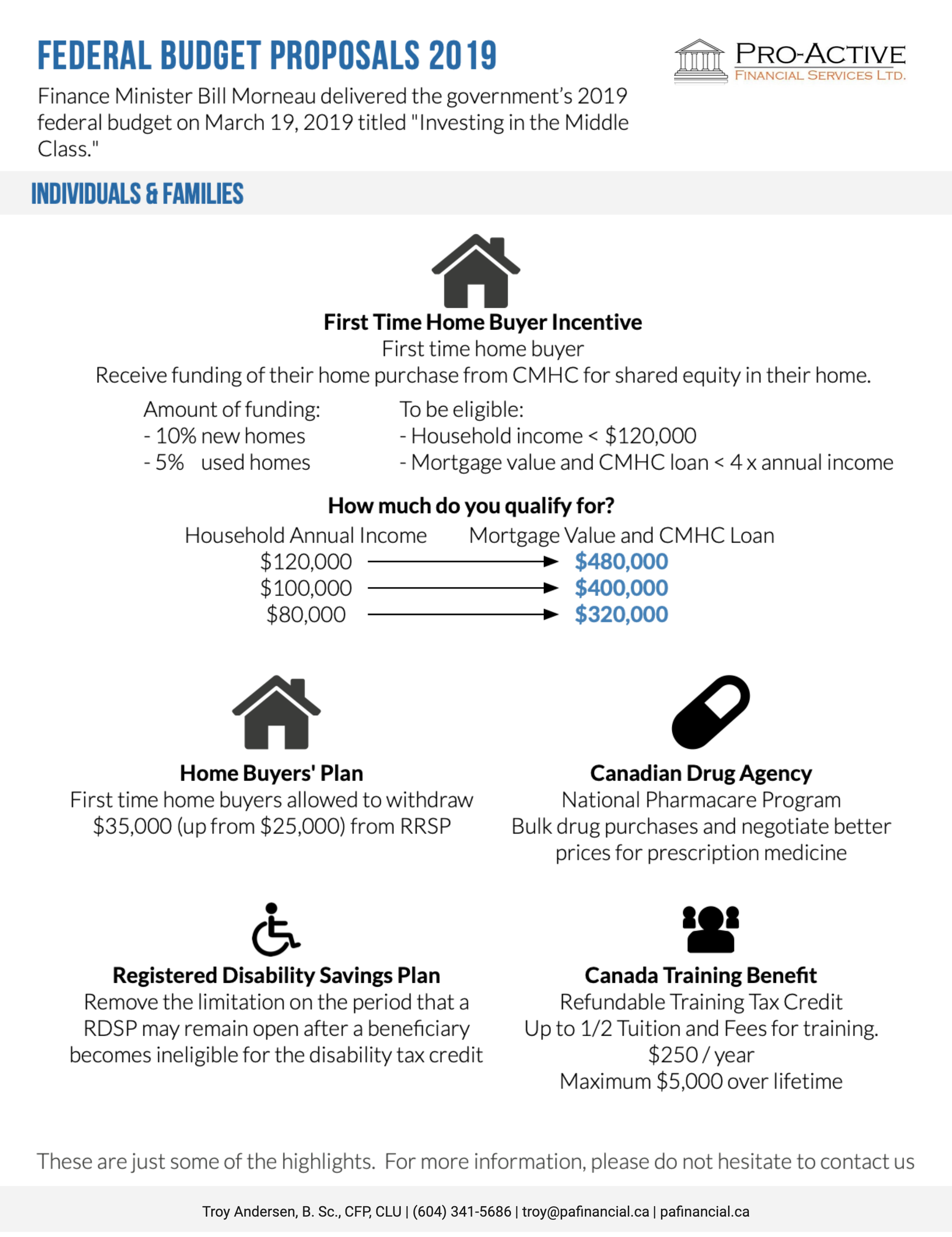
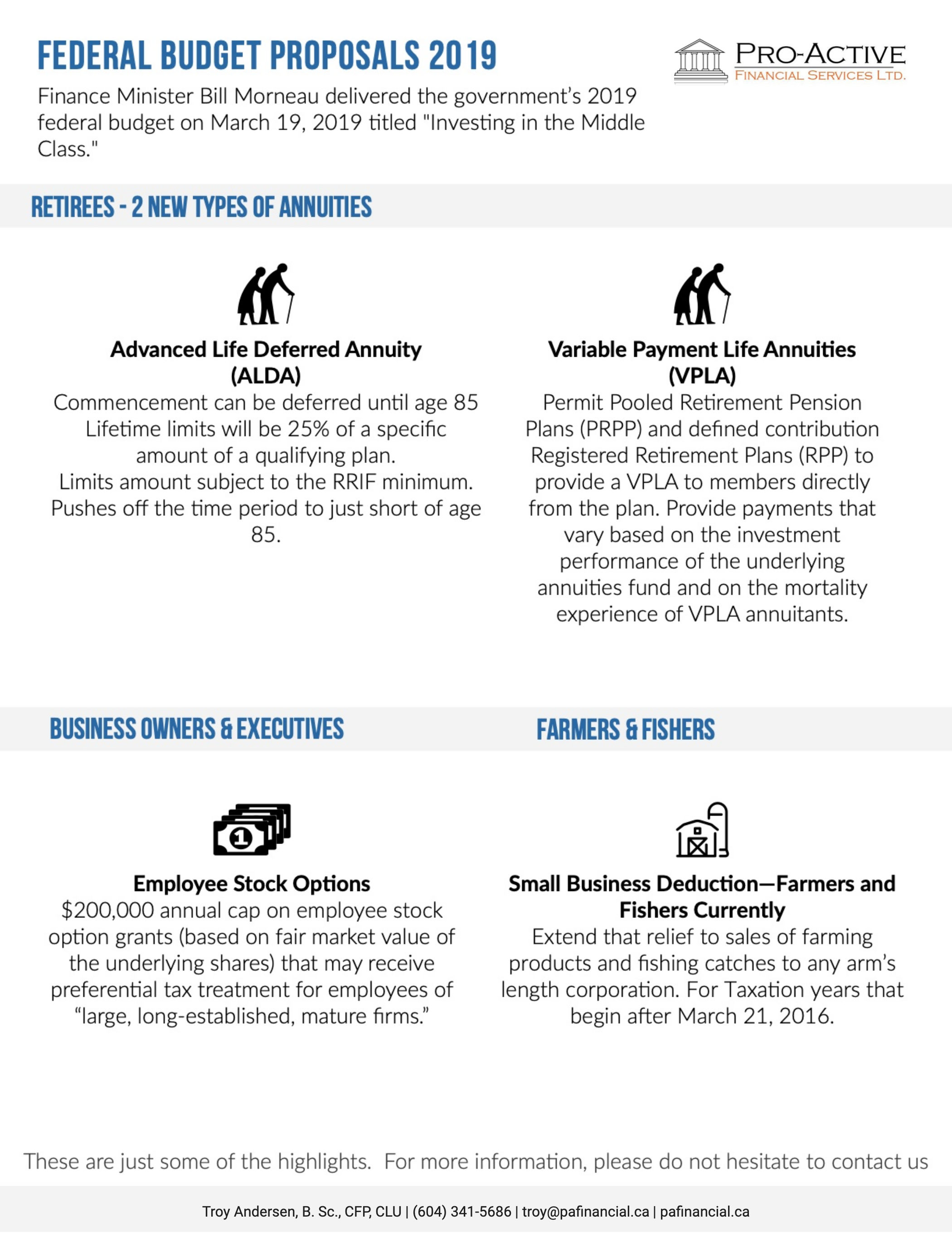
The 2019 budget is titled “Investing in the Middle Class. Here are the highlights from the 2019 Federal Budget.

We’ve put together the key measures for:

  • Individuals and Families

  • Business Owners and Executives

  • Retirement and Retirees

  • Farmers and Fishers

Individuals & Families

Home Buyers’ Plan

Currently, the Home Buyers’ Plan allows first time home buyers to withdraw $25,000 from their Registered Retirement Savings Plan (RRSP), the budget proposes an increase this to $35,000.

First Time Home Buyer Incentive

The Incentive is to provide eligible first-time home buyers with shared equity funding of 5% or 10% of their home purchase price through Canada Mortgage and Housing Corporation (CMHC).

To be eligible:

  • Household income is less than $120,000.

  • There is a cap of no more than 4 times the applicant’s annual income where the mortgage value plus the CMHC loan doesn’t exceed $480,000.

The buyer must pay back CMHC when the property is sold, however details about the dollar amount payable is unclear. There will be further details released later this year.

Canada Training Benefit

A refundable training tax credit to provide up to half eligible tuition and fees associated with training. Eligible individuals will accumulate $250 per year in a notional account to a maximum of $5,000 over a lifetime.

Canadian Drug Agency

National Pharmacare program to help provinces and territories on bulk drug purchases and negotiate better prices for prescription medicine. According to the budget, the goal is to make “prescription drugs affordable for all Canadians.”

Registered Disability Savings Plan (RDSP)

The budget proposes to remove the limitation on the period that a RDSP may remain open after a beneficiary becomes ineligible for the disability tax credit. (DTC) and the requirement for medical certification for the DTC in the future in order for the plan to remain open.

This is a positive change for individuals in the disability community and the proposed measures will apply after 2020.

Business Owners and Executives

Intergenerational Business Transfer

The government will continue consultations with farmers, fishes and other business owners throughout 2019 to develop new proposals to facilitate the intergenerational transfers of businesses.

Employee Stock Options

The introduction of a $200,000 annual cap on employee stock option grants (based on Fair market value) that may receive preferential tax treatment for employees of “large, long-established, mature firms.” More details will be released before this summer.

Retirement and Retirees

Additional types of Annuities under Registered Plans

For certain registered plans, two new types of annuities will be introduced to address longevity risk and providing flexibility: Advanced Life Deferred Annuity and Variable Payment Life Annuity.

This will allow retirees to keep more savings tax-free until later in retirement.

Advanced Life Deferred Annuity (ALDA): An annuity whose commencement can be deferred until age 85. It limits the amount that would be subject to the RRIF minimum, and it also pushes off the time period to just short of age 85.

Variable Payment Life Annuity (VPLA): Permit Pooled Retirement Pension Plans (PRPP) and defined contribution Registered Retirement Plans (RPP) to provide a VPLA to members directly from the plan. A VPLA will provide payments that vary based on the investment performance of the underlying annuities fund and on the mortality experience of VPLA annuitants.

Farmers and Fishers

Small Business Deduction

Farming/Fishing will be entitled to claim a small business deduction on income from sales to any arm’s length purchaser. Producers will be able to market their grain and livestock to the purchaser that makes the most business sense without worrying about potential income tax issues. This measure will apply retroactive to any taxation years that began after March 21, 2016.

To learn how the budget affects you, please don’t hesitate to contact us.

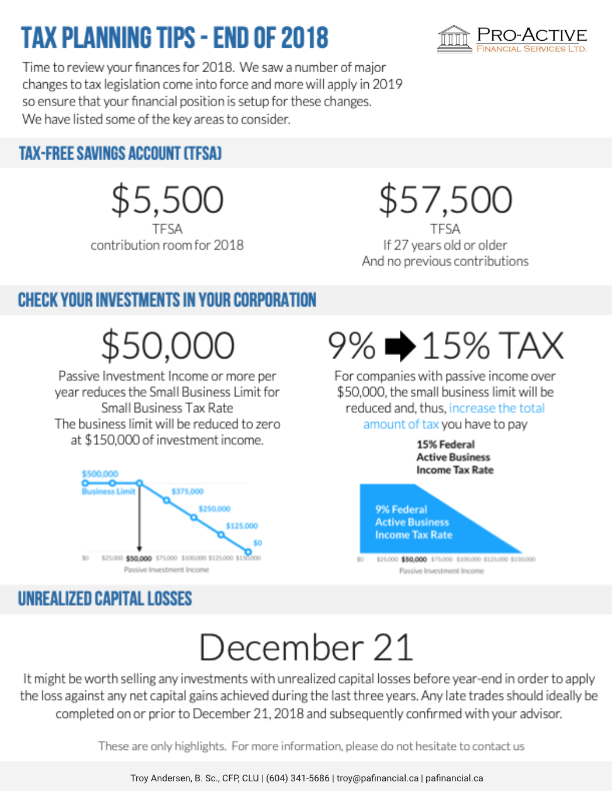
Tax Planning Tips for End of 2018

Now that we are nearing year end, it’s a good time to review your finances. 2018 saw a number of major changes to tax legislation come in force and more will apply in 2019, therefore you should consider available opportunities and planning strategies prior to year-end.

Below, we have listed some of the key areas to consider and provided you with some useful tips to make sure that you cover all of the essentials.

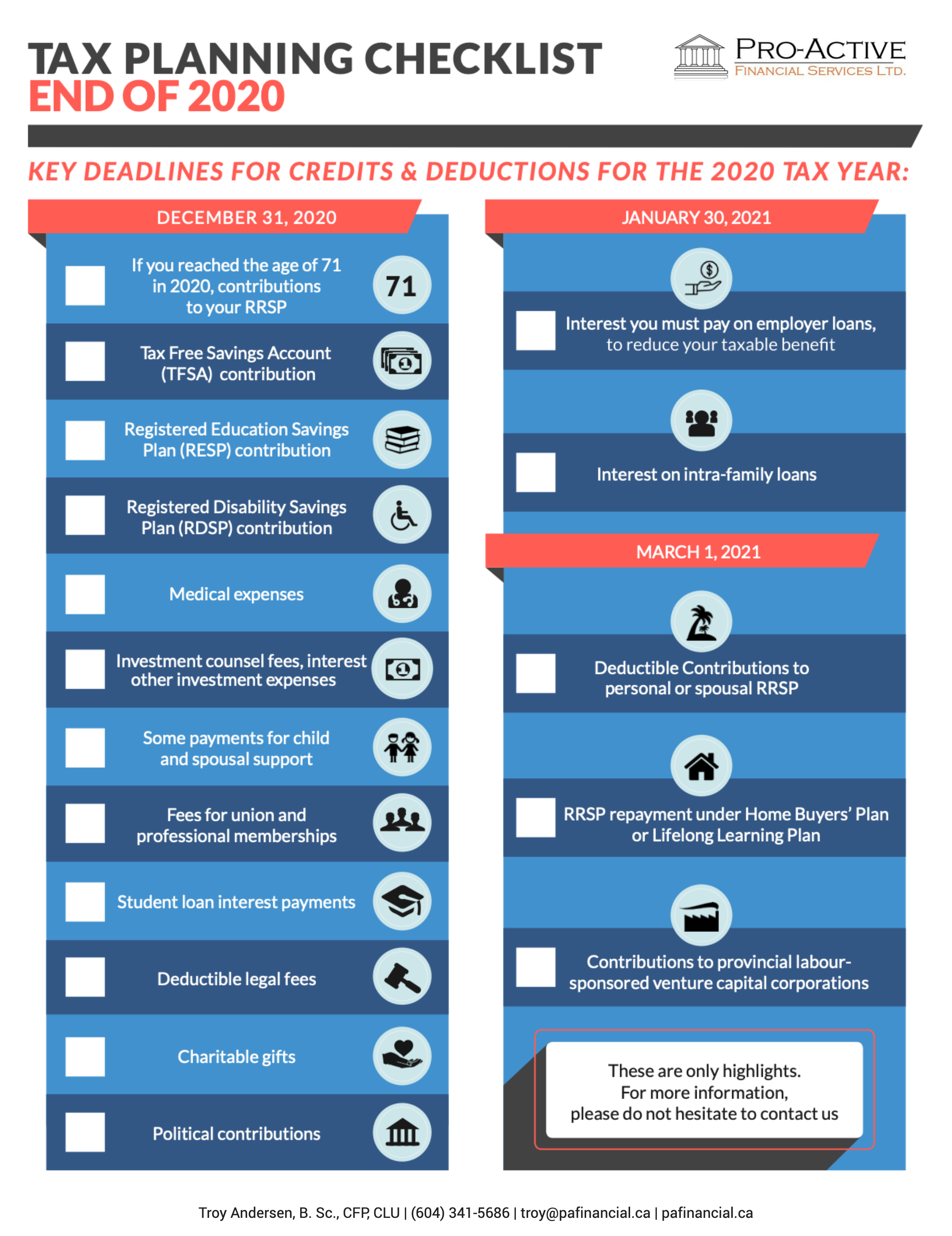
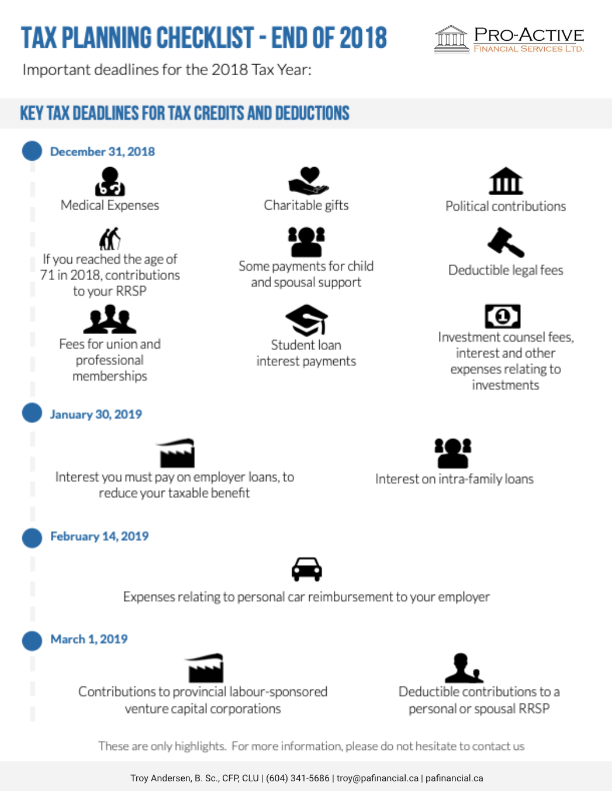
Key Tax Deadlines for 2018 Savings

December 31, 2018:

  • Medical expenses

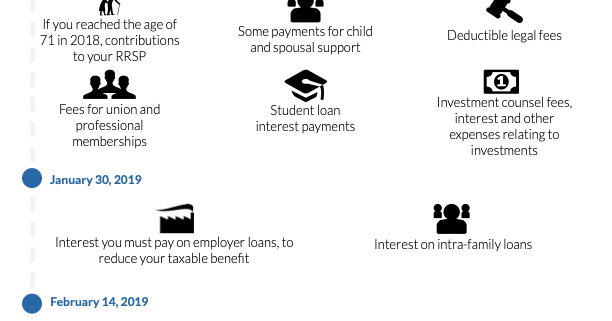
  • Fees for union and professional memberships

  • Charitable gifts

  • Investment counsel fees, interest and other expenses relating to investments

  • Student loan interest payments

  • Political contributions

  • Deductible legal fees

  • Some payments for child and spousal support

  • If you reached the age of 71 in 2018, contributions to your RRSP

January 30, 2019

  • Interest on intra-family loans

  • Interest you must pay on employer loans, to reduce your taxable benefit

February 14, 2019

  • Expenses relating to personal car reimbursement to your employer

March 1, 2019

  • Contributions to provincial labour-sponsored venture capital corporations

  • Deductible contributions to a personal or spousal RRSP

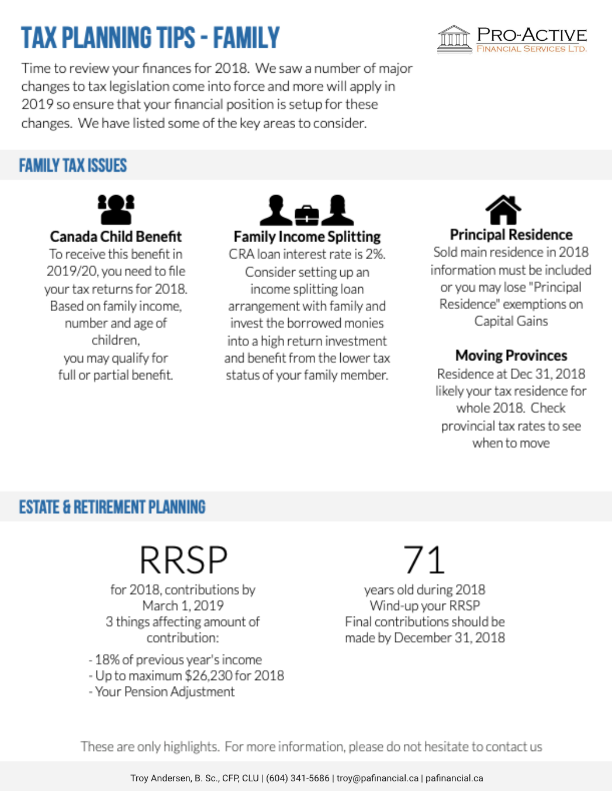
Family Tax Issues
  • Check your eligibility to the Canada Child Benefit
    In order to receive the Canada Child Benefit in 2019/20, you need to file your tax returns for 2018 because the benefit is calculated using the family income from the previous year. Eligibility depends on set criteria such as your family’s income and the number and age of your children and you may qualify for full or partial amount.

  • Consider family income splitting
    The CRA offers a low interest rate on loans and it therefore makes sense to consider setting up an income splitting loan arrangements with members of your family, whereby you can potentially lock in the family loan at a low interest rate of 2% and subsequently invest the borrowed monies into a higher return investment and benefit from the lower tax status of your family member. Don’t forget to adhere to the new Tax on Split Income rules.

  • Have you sold your main residence this year?
    If so, your 2018 personal tax return must include information regarding the sale or you may lose any “principal residence” exemptions on the capital gains from the sale and thus make the sale taxable.

  • If you’re moving, think carefully about your moving date
    If you are moving to a new province, it’s worth noting that your residence at December 31, 2018 is likely to be the one that your taxes are due to for the whole of the 2018 year. Therefore, if your move is to a province with higher taxes, putting your move off until 2019 may therefore make sense, and vice versa if you are moving to a lower tax province.

Managing Your Investments
  • Use up your TFSA contribution room
    If you are able, it’s worth contributing the full $5,500 to your TFSA for 2018. You can also contribute more (up to $57,500) if you are 27 or older and haven’t made any previous TFSA contributions.

  • Check if you have investments in a corporation
    The new passive investment income rules apply to tax years from 2018 and you therefore need to plan ahead if the rules affect you. They state that the small business deduction is reduced for companies which are affected with between $50,000 and $150,000 of investment income, therefore the small business deduction has been stopped completely for corporations which earn passive investment income of more than $150,000.

  • Think about selling any investments with unrealized capital losses
    It might be worth doing this before year-end in order to apply the loss against any net capital gains achieved during the last three years. Any late trades should ideally be completed on or prior to December 21, 2018 and subsequently confirmed with your broker. Conversely, if you have investments with unrealized capital gains which are not able to be offset with capital losses, it may be worth selling them after 2018 in order to be taxed on the income the following year.

Estate and Retirement Planning
  • Make the most of your RRSP
    The deadline for making contributions to your RRSP for the year 2018 is March 1, 2019. There are three things that affect how much you may contribution towards your RRSP, as follows:

    • 18% of your previous year’s earned income

    • Up to a maximum of $26,230 for 2018 and $26,500 for 2019

    • Your pension adjustment

Remember that deducting your RRSP contribution reduces your after-tax cost of making said contribution.

  • Check when your RRSP is due to end
    You should wind-up your RRSP if you reached the age of 71 during 2018 and your final contributions should be made by December 31, 2018.

Other Considerations
  • Make your personal tax instalments
    If you pay your final 2018 personal tax instalment by December 15, 2018, you won’t pay interest or penalty charges. Similarly, if you are behind on these instalments, you should try to make “catch-up” payments by that date. You can also offset part or all of the non-deductible interest that you would have been assessed if you make early or additional instalment payments.

  • Remember the deadline for making a taxpayer-relief request
    The deadline is December 31, 2018 for making a tax-payer relief request related to the 2008 tax year.

  • Consider how to minimize the taxable benefit for your company car
    The taxable benefit applied to company cars is comprised of two parts – a stand-by charge and an operating-cost benefit. If you drive a company car, it’s worth considering how to potentially minimize both of these elements. The taxable benefit for operating costs is $0.26 per km of personal use, therefore you should make sure that you reimburse your employer where relevant, by the deadline of February 14, 2019.

Contact us if you have any questions, we can help.

Why provide an employee benefits plan?

Business owners are increasingly recognizing the key importance of implementing employee benefit plans in their organization and this is an area that has grown considerably in recent decades. Employee benefits comprise all of the additional things that you offer to your employees on top of their regular salary, which could include pension contributions, health cover / insurance policies, training and education programs etc. Employees are more and more interested in the total benefits package that a potential employer can offer them, rather than just being focused on a binary salary figure and recognizing and understanding this cultural shift in the modern working world is crucial to maintain your ability to recruit and retain the right talent for your business.

Many employees value the benefits that their employer offers, considering them an integral part of their take home pay, none more so than health cover. This benefit can provide financial and emotional security to your employees and their families, without the need for them to complete any health requirements to be on the plan. They are likely to benefit from a preferable level of cover and the plan may even provide them with insurance products such as long-term disability cover, which can be harder to gain outside of a group plan. What’s more, group plans often offer out-of-country emergency healthcare for employees which has the potential to save them money on personal travel insurance products.

Not only do these benefits provide a sense of security to your employees, they can also help them to feel valued as part of your organization, which may in turn foster higher morale and increased motivation within their roles. It is therefore worthwhile for business owners to encourage their teams to recognize the fact that the benefits package that you offer should be considered as an integral part of their take home pay, alongside their actual salary.

Talk to us, we can help.