
Pro Active Financial
  • HOME
  • ABOUT
    • ABOUT
    • PRIVACY & TERMS OF USE
  • SERVICES
    • BUSINESS
      • BUSINESS CONTINUATION
      • BUSINESS SUCCESSION
      • EXECUTIVE BENEFITS
      • GROUP BENEFITS
    • LIFE STAGES
      • STARTING YOUR CAREER
      • GROWING FAMILIES
      • MATURING FAMILIES
      • PREPARING FOR RETIREMENT
      • RETIREES
    • INSURANCE
      • LIFE INSURANCE
      • DISABILITY INSURANCE
      • CRITICAL ILLNESS INSURANCE
      • LONG TERM CARE
    • INVESTMENTS
      • Tax Free Savings Account
      • Segregated Fund
      • Registered Retirement Savings Program
      • Registered Education Savings Plan
      • Registered Retirement Income Fund
      • Registered Disability Savings Plan
  • RESOURCES
  • BLOG
  • CONTACT
  • Search
  • Menu Menu
  • LinkedIn

Retirement Planning for Business Owners

September 3, 2018/in blog, Business Owners, corporate, Retirees, RRSP, tax, Tax Free Savings Account/by Pro Active Financial Services Ltd.

Retirement planning can be a complex process for us all, but if you are the owner of a small business it may can get even more complicated, due to the various factors and circumstances that you have to take into consideration. A common mistake made by small business owners is reinvesting extra money to grow their business, at the expense of putting it aside to save for their retirement.

Although there is no magic formula for getting started on a retirement strategy for your business, there are some general principles which might help you to get a handle on the steps that you need to take. One of the key ideas is the consideration of both your business and your personal finances and how to structure and integrate the two in order to create a robust retirement financial strategy.

Here are some tips on how to get started on a retirement plan.

  • Set aside time to plan for the future – It’s important to make retirement planning a priority, or you run the risk of never getting around to it. A professional financial planner can help you to assess your personal circumstances and create a personalized plan that suits you and your business, with the right balance between saving and reinvestment to help your business to grow.

  • Think about your future retirement income – Here are the main sources of retirement income that small business owners usually rely on:
  • Equity held in your business – If your business is successful, you are likely to benefit from equity from it in your retirement. Selling your company is an option, particularly attractive to some as, in some cases, you could benefit from the lifetime capital gains exemption on the sale. Of course, finding the right person to run your business in the future is easier said than done. A clear succession plan, created in advance of your retirement, can help you to ensure that business continuity will be affected as little as possible and will give you peace of mind as you approach your retirement. You may also want to consider using the expertise of an accountant or mergers and acquisitions specialist to help you to value your business correctly and also look after your interests when liaising with potential purchasers.

  • Alternatively, you may choose for your children to inherit your business, or you may decide to retain ownership of dividend-paying preferred shares in order to maintain an ongoing source of income.

  • Registered plans – A Registered Retirement Savings Plan (RRSP) can offer personal tax deductions on your contributions, plus your savings will grow as tax-deferred whilst in the plan. In addition, tax-free savings accounts (TFSAs) can be a useful way to save tax-free in particular circumstances.

  • Consider offering a retirement savings plan to your employees – Paying your statutory contribution of the Canada Pension Plan is just the minimum – many small businesses choose to offer their employees enhanced pension contributions as an incentive or employee benefit. For example, you could match their RRSP contributions to a set limit, to help their retirement nest grow more quickly. Alternatively, you could offer a benefit plan with an investment contribution package from an insurance company, which can be a more straightforward and cost-effective choice.

  • Be sure to diversify – As a small business owner, you should avoid putting all of your eggs in one basket, financially speaking, as this could leave you vulnerable to changes in the market. Try to diversify your investments and spread your funds in order to protect yourself and engage the help of a professional where necessary to help you to do so.

In summary, it’s important to remember that retirement planning is a process which is unique and personal to your own and your business’ circumstances and there is no uniform approach which works across the board. Take time to take stock of your current situation, as well as your goals for the future and this will help you to create a retirement plan that is right for your needs, both current and future.

https://pafinancial.ca/wp-content/uploads/2018/09/Retirement_planning_business_owners.png 600 600 Pro Active Financial Services Ltd. https://pafinancial.ca/wp-content/uploads/2018/02/proActiveLogo.png Pro Active Financial Services Ltd.2018-09-03 06:33:002018-09-03 06:48:05Retirement Planning for Business Owners

6 Steps to Retirement Success

July 1, 2018/in blog, Business Owners, Families, Investment, Retirement Savings, Tax Free Savings Account/by Pro Active Financial Services Ltd.

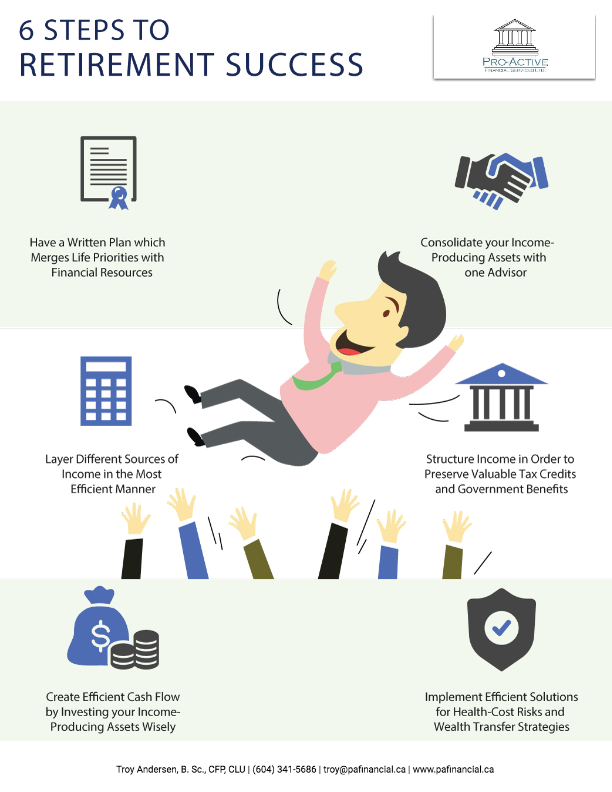
 Retirement planning can be challenging, we’ve outlined what we feel are 6 steps to retirement success. 

  • Have a written plan which merges life priorities with financial resources.
  • Consolidate your income-producing assets with one advisor.
  • Layer different sources of income in the most efficient manner.
  • Structure income in order to preserve valuable tax credits and government benefits.
  • Create efficient cash flow by investing your income-producing assets wisely.
  • Implement efficient solutions for health-cost risks and wealth transfer strategies.

Talk to us about a complimentary comprehensive review of your retirement plan.


https://pafinancial.ca/wp-content/uploads/2018/07/retirementPlanning-Troy-Andersen.png 792 612 Pro Active Financial Services Ltd. https://pafinancial.ca/wp-content/uploads/2018/02/proActiveLogo.png Pro Active Financial Services Ltd.2018-07-01 15:00:002018-07-01 15:09:026 Steps to Retirement Success

Getting the best from a financial advisor

April 1, 2018/in blog, Business Owners, Charitable Gifting, corporate, disability, Estate Planning, Family, Group Benefits, health benefits, Individuals, Investment, life insurance, long term care, pension plan, Retirees, RRSP, tax, Tax Free Savings Account, travel insurance/by Pro Active Financial Services Ltd.

Working with a professional to help you to make sense of your finances can be a wise move, but for this relationship to work effectively it is important that you understand what to expect from your financial advisor.

What can your financial advisor help you with?

  • Defining your financial goals and creating a step by step plan or strategy to achieve them.
  • Planning for the future, including for retirement, future education or housing needs.
  • Choosing the mix of investments and assets that suit your goals, lifestyle, time horizon and appetite for risk.
  • Building a solid estate for your family to inherit in the future.
  • Choosing the most tax-efficient methods of saving and investing.

What should your financial advisor inform you of?

  • The range of services that they offer and how much and by which method you will compensate them.
  • Your mutual responsibilities and obligations towards each other.
  • What the planning process will look like and the documents that they will provide you with.

What will your financial advisor need from you or need to ask you about?

  • What your financial goals are.
  • What your personal circumstances – such as your marital status, any dependents, your job, earnings and tax situation.
  • Any investments or assets that you currently have – such as registered accounts, workplace pensions, property etc.
  • Your appetite for risk and investment preferences.
  • Information on your income and also your outgoings, including debts such as mortgages, loans or credit cards.
  • Whether or not you have a will, and its contents.
  • Your estate and inheritance planning situation.

If you’re looking to achieve your financial goals, talk to us. We can help. 

https://pafinancial.ca/wp-content/uploads/2018/04/Getting_the_best_from_a-Financial_advisor.png 600 600 Pro Active Financial Services Ltd. https://pafinancial.ca/wp-content/uploads/2018/02/proActiveLogo.png Pro Active Financial Services Ltd.2018-04-01 15:44:002018-04-07 15:54:08Getting the best from a financial advisor

Comparing TFSAs and RRSPs

February 16, 2018/in Family, Individuals, Investment, Retirees, RRSP, tax, Tax Free Savings Account/by Pro Active Financial Services Ltd.

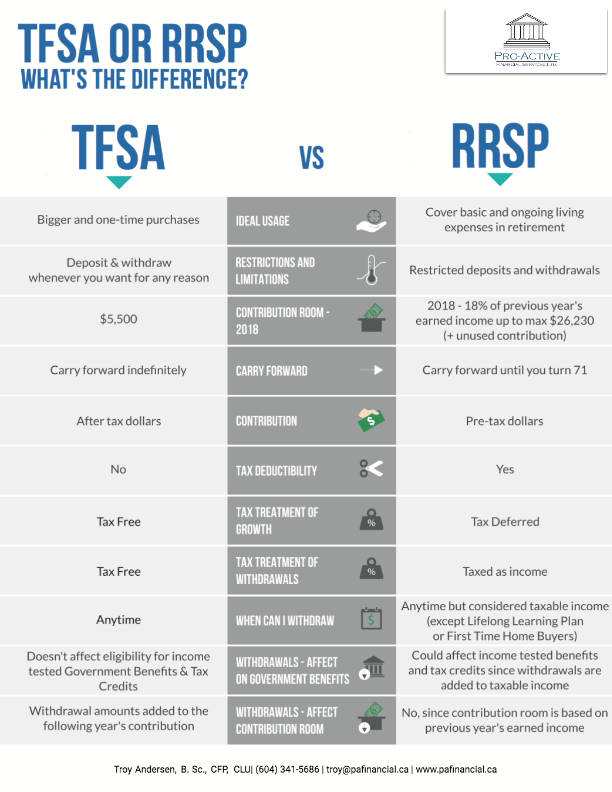
If you are seeking ways to save in the most tax-efficient manner available, TFSAs and RRSPs can both be effective options for you to achieve your savings goals more quickly. However, each plan does have distinct differences and advantages / disadvantages. Let’s take a look at their key features:

  • While a TFSA can be used for any type of savings, an RRSP is used exclusively for retirement savings.
  • You can enjoy tax free withdrawals from your TFSA due to the fact that you make your contributions after you have paid tax, whereas the opposite is true for withdrawals from your RRSP (except in the case of lifelong learning plan and home buyers’ plan)
  • TFSA contributions aren’t tax deductible whereas RRSP contributions are i.e. with an RRSP, you can deduct the contributions that you make from your income when you file your tax return.
  • It is required that you use earned income to contribute towards your RRSP but this is not the case for your TFSA.
  • You can continue to contribute towards your TFSA for as long as you like, whereas you must close your RRSP and stop contributing towards it when you turn 71 and purchase an annuity or convert it to a RRIF with the savings that you have made within the plan.
  • You are able to specify your spouse as your beneficiary with both your TFSA and your RRSP, however there is a key difference with how your savings are treated upon your spouse’s death. With an RRSP, there will be taxes payable upon the monies left in the plan by your children who inherit it, whereas with a TFSA, tax is only paid on the increase in the value of the plan since the date of death in the year that it is inherited by your children. What’s more, no tax is payable if the value that they receive is less than the value of the TFSA at the time of death.

In summary, your individual circumstances will dictate which plan is the most appropriate for you, depending on your tax position and withdrawal intentions. The primary difference between both plans is the timing of the taxes payable i.e. if you want to defer the payment of your taxes, particularly if your marginal tax rate will be lower in retirement, an RRSP may be more beneficial for you. Alternatively, if your marginal tax rate will be higher when you plan to make withdrawals, a TFSA may suit you better.

https://pafinancial.ca/wp-content/uploads/2018/02/ComparingTFSAandRRSP-2.png 800 800 Pro Active Financial Services Ltd. https://pafinancial.ca/wp-content/uploads/2018/02/proActiveLogo.png Pro Active Financial Services Ltd.2018-02-16 04:33:002018-02-16 04:36:10Comparing TFSAs and RRSPs

2018 Financial Calendar

January 1, 2018/in blog, Family, Individuals, Investment, mortgage, pension plan, Retirees, RRSP, tax, Tax Free Savings Account/by Pro Active Financial Services Ltd.

https://pafinancial.ca/wp-content/uploads/2018/01/2018calendar-2.jpg 1200 1200 Pro Active Financial Services Ltd. https://pafinancial.ca/wp-content/uploads/2018/02/proActiveLogo.png Pro Active Financial Services Ltd.2018-01-01 14:00:002018-01-01 14:05:162018 Financial Calendar
Page 3 of 3123

Subscribe to our newsletter

Search Blog Posts

Categories

  • 2019 Only
  • 2020
  • 2020 Only
  • 2021
  • 2022
  • 2022 Only
  • 2023
  • 2024
  • 2025
  • 2026
  • Accountants
  • blog
  • Business Owners
  • business owners
  • Buy Sell
  • Charitable Gifting
  • CLU Comment
  • Coronavirus
  • Coronavirus – Associates
  • Coronavirus – Practice Owners
  • Coronavirus – Retired
  • Coronavirus – Retiring
  • Coronavirus – Students
  • corporate
  • Critical Illness
  • critical illness insurance
  • Debt
  • dental benefits
  • disability
  • disability insurance
  • education
  • Estate Planning
  • Families
  • Family
  • farmers
  • financial advice
  • financial planning
  • Government Budget
  • Group Benefits
  • health benefits
  • incorporated professionals
  • Individuals
  • Insurance
  • Investment
  • life insurance
  • long term care
  • mortgage
  • pension plan
  • permanent insurance
  • personal finances
  • Professional Corporations
  • Professionals
  • RDSP
  • Registered Education Savings Plan
  • RESP
  • Retirees
  • Retirement
  • Retirement Savings
  • RRSP
  • tax
  • Tax Free Savings Account
  • term insurance
  • travel insurance

Tags

beneficiary blog business business owners business succession cancer Carry forward information Carying charges Charitable donations children critical illness debt Education employee benefits estate estate planning families funeral expenses heart attack individuals individuals,families,life insurance,business owners,beneficiary,smoking,marital status,children Insurance Interest expense key person Life Insurance lump sum benefit marital status Medical expenses Mortgage Registered Retirement Savings Plan RESP retirement retirement contribution room RRSP smoking starting a family stroke tax tax free savings account TFSA TOSI

Contact Us

Troy Andersen
Certified Financial Planner®
President

Tel: 604-341-5686
Email: troy@pafinancial.ca

16741 – 84A Avenue
Surrey, BC
V4N 4W2

Latest News

  • Tax Lines to Look Out For on Your 2025 Canadian Tax ReturnApril 1, 2026 - 8:12 pm
  • 2026 Canada Money FactsMarch 2, 2026 - 8:25 pm
  • B.C. Budget 2026: What It Means for YouFebruary 19, 2026 - 5:43 pm
  • Tax Free Savings Account 2026February 2, 2026 - 9:29 pm
  • 2026 Financial CalendarDecember 31, 2025 - 9:12 pm

About

We specialize in providing consulting for Employee benefits including group investment products and Executive benefits and make it understandable for our clients. Service is the cornerstone of our firm. We serve a broad array of clientele; from small businesses to large corporations. As every client is unique we take pride in understanding our clients’ needs and helping them achieve their goals. Being true independent brokers, we only work for our clients and not for any one insurance company. Service matched with solid processes and integrity are the cornerstones of our company. We look forward to working with you now and in the future.

Our Dealer

Mutual funds are distributed through Desjardins Financial Security Investments Inc.

 
Disclaimer & Legal Information

Subscribe to our newsletter

©2017 Financial Tech Tools Inc. | Privacy Statement and Terms of Use
  • LinkedIn
Scroll to top
Cleantalk Pixel