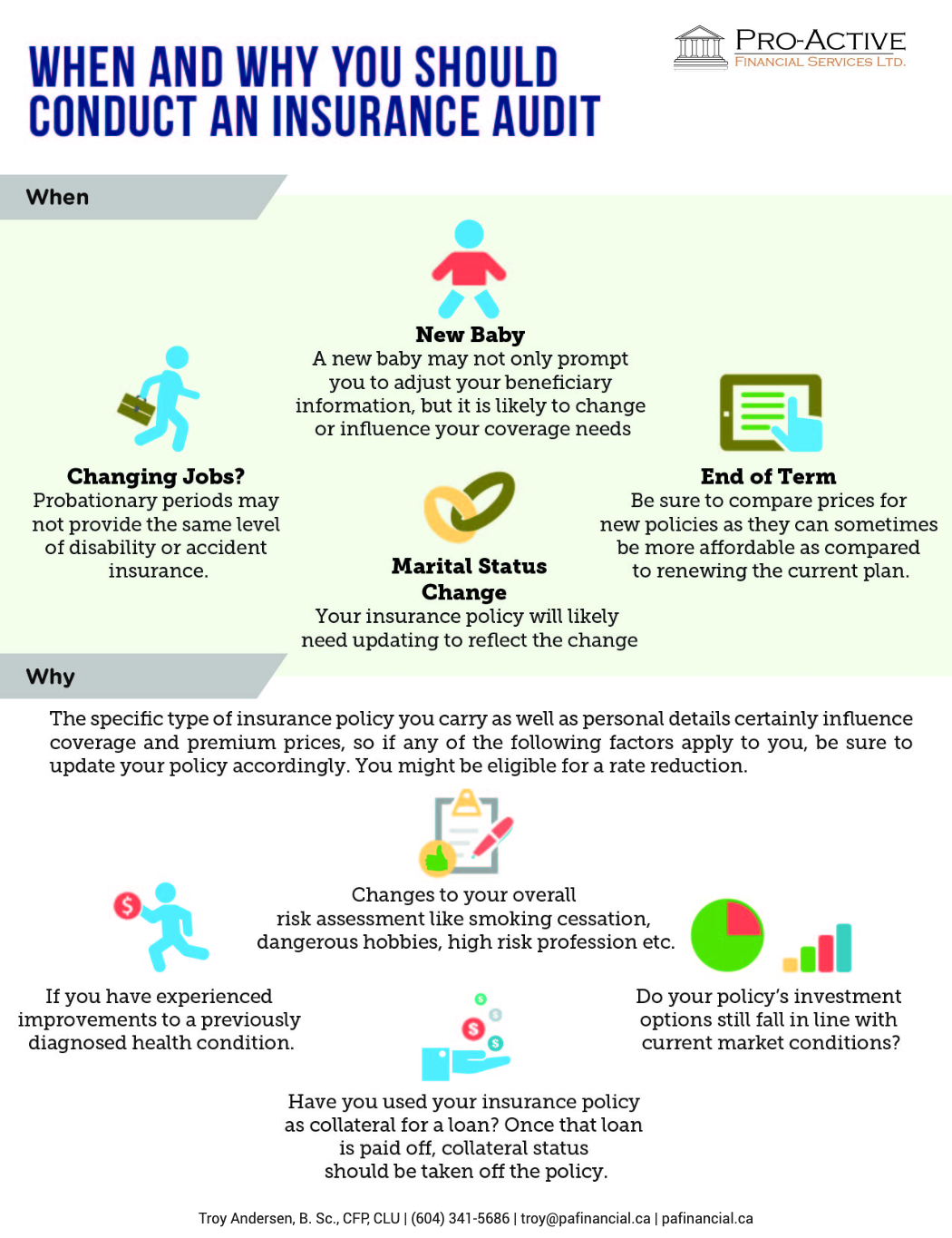

When and Why You Should Conduct an Insurance Audit

As our lives grow and change with variable circumstances, new additions, and job transitions, our needs for insurance will also evolve. Additionally, economic fluctuations and external circumstances that influence your insurance policy will need frequent re-evaluation to ensure that you are making the most appropriate and financially favorable decisions. Perhaps you aren’t sure whether you should conduct an insurance audit or not. The following scenarios are usually a good indication that you should thoroughly assess and review your current policy contract: 

  • Bringing new life into your family? A new baby may not only prompt you to adjust your beneficiary information, but it is likely to change or influence your coverage needs.

  • Changing jobs? Probationary periods may not provide the same level of disability or accident insurance.

  • Is your policy nearing the end of its term? Be sure to compare prices for new policies as they can sometimes be more affordable as compared to renewing the current plan.

  • Has your marital status changed? Your insurance policy will likely need updating to reflect such.

The specific type of insurance policy you carry as well as personal details certainly influence coverage and premium prices, so if any of the following factors apply to you, be sure to update your policy accordingly. You might be eligible for a rate reduction. 

  • Changes to your overall risk assessment like smoking cessation, dangerous hobbies, high risk profession etc.

  • If you have experienced improvements to a previously diagnosed health condition.

  • Do your policy’s investment options still fall in line with current market conditions?

  • Have you used your insurance policy as collateral for a loan? Once that loan is paid off, collateral status should be taken off the policy.

Insurance policies generated for business purposes should also be regularly reviewed to make sure the policy still offers adequate coverage to meet the needs of the company and includes the appropriate beneficiary information. With life happening so quickly, it can be easy to forget about keeping insurance policies up to date, however, major changes can have a profound impact on coverage and premiums. Be sure to conduct insurance audits often to ensure your policies are still meeting your needs. 

Contact us to see how we can help. 

Don’t lose all your hard-earned money to taxes

Don’t lose all your hard-earned money to taxes

Tax planning is an essential part of managing your money – both while living and after your death. You want to maximize the amount of money to your beneficiaries, not the government. We have three tips to help you reduce taxes on your hard-earned money:

  1. Make the most of the lifetime capital gains exemption

  2. Decrease your end-of-life tax bill

  3. Look into Immediate Financing Arrangements

Lifetime capital gains exemption

The good news is that you can save a lot of money on taxes using the lifetime capital gains exemption. The bad news is that you could lose out on some of those savings unless you follow all the appropriate steps. Having a financial team to guide you through these steps is essential. When it comes to selling all or part of your business, your lawyer, accountant, and financial advisor must be all on the same page.

End-of-life tax bill

As with the lifetime capital gains exemption, working with your financial team to ensure your affairs are in order is crucial. Without the proper paperwork, your hard-earned money may not go to the family members, friends, or charities you want to support. Take the time to ensure that your wishes are properly documented and that you have filled out all essential paperwork.

Consider an Immediate Financing Arrangement

An Immediate Financing Arrangement (IFA) lets your business:

  • Get a life insurance premium on behalf of a shareholder

  • Create a tax deduction

  • Transfer assets tax-free from the business to a shareholder’s estate

Also, you can use an IFA to help increase your business’ cash flow by pledging the life insurance policy as collateral for a loan. The loan can be invested into the business or other investments if the company does not need the additional cash flow.

The Takeaway

While this can all seem overwhelming, it is essential to make sure you take the proper steps to protect your business and minimize your tax bill. But you don’t have to do this alone – contact us today for expert advice and guidance.

Five Ways To Withdraw Money From Your Business In A Tax-Efficient Manner

Five Ways To Withdraw Money From Your Business In A Tax-Efficient Manner

You have worked long and hard to build up your business, and now you are ready to withdraw money from your business’ bank account. But you don’t want to get hit with a huge tax bill. So here are 5 ways to withdraw money from your business in a tax-efficient manner.

1) Pay Yourself And Your Family Members

You can pay yourself a salary from your business and pay any family members who work in your business. However, the salary you pay family members must not be excessive – it must be in line with what they would receive for doing the same work elsewhere.

You and your family members will be taxed at the regular personal marginal tax rates on your salaries. However, your corporation can make a deduction based on salaries paid when determining taxable income.

2) Pay Out Taxable Dividends

You can use dividends to distribute money from your corporation to both yourself and family members if everyone holds shares in your corporation. However, when distributing dividends to a shareholder, it is critical to consider both the tax on split income (TOSI) rules and the corporate attribution rules before any distribution is made.

  • TOSI rules – Under the current income tax rules, the TOSI applies the highest marginal tax rate (currently 33%) to “split income” of an individual under the age of 18. In general, an individual’s split income includes certain taxable dividends, taxable capital gains and income from partnerships or trusts. – Canada.ca

  • Corporate attribution rules – Corporate attribution rules may result in additional tax if a transfer or loan to a corporation is made to shift income to another family member. This can result in additional tax for the individual making the transfer or loan.

3) Pay Out Capital Dividends

Another way to pay out dividends is via your corporation’s capital dividend account (CDA). Money in your corporation’s CDA can be dispersed to Canadian resident shareholders as a tax-free dividend, but be sure you are clear on what can legally be allowed in your CDA before you do this.

4) Adjust Your Salary And Dividend Mix

Keeping the right mix when paying yourself a salary and paying yourself via dividends is essential. You need to consider various factors – such as your cash flow needs, earned income for RRSP contributions, and any impact on taxes and other regulatory requirements – paying out salaries and dividends can have.

5) Repay Any Outstanding Shareholder Loans

If you loaned money to your company in the form of a shareholder loan, now may be the time to have your company repay that loan. Any money you receive to settle your shareholder loan will be paid to you as a tax-free distribution.

The Takeaway

Regardless of why you need to take cash out of your business, it is crucial to plan how to withdraw the money so you can do it in the most tax-efficient manner possible. Unfortunately, there is no one-size-fits-all solution for this, which is why talking to a professional advisor is so important.

We can help design a tax-optimized compensation strategy for you. Contact us to set up a meeting today!

Estate Planning for Blended Families

Blended families – where two people get married but have children from previous relationships – are becoming more common. It can be challenging enough to take care of the everyday logistics; from where to live to making sure everyone gets along. So trying to make sure you properly take of estate planning often doesn’t get taken care of.

In most families – blended or not – spouses leave everything to each other. Then, when the surviving spouse dies, the remainder is divided amongst all of the children. The problem with this setup is that there is no guarantee that the surviving spouse will not remarry and inadvertently disinherit the deceased’s children.

To make sure that everyone is treated fairly, it’s essential to consider how to handle each of the following estate planning issues for blended families:

  • Sharing the Family Home

  • Make the Most of a Registered Retirement Savings Plan

  • How to Share Non-Registered Investments and Other Assets

  • Why It’s Important to Select a Good Trustee

  • The Advantages of Life Insurance for Blended Family Estate Planning

It’s essential to have a full discussion with your spouse and children to avoid misunderstandings and reduce uncertainty. But you don’t have to do it alone! We can provide you with tailored solutions to ensure your wishes are carried out.

Sharing The Family Home

This can be challenging, depending on whether the blended family moves into a new home or into a house one spouse already owns. An option to consider is that the spouse who is moving into the home already owned by the other spouse can then purchase an interest in the family home. If this occurs, each spouse can own the home as tenants-in-common, enabling them to manage their interest in the house separately.

When it comes time for each spouse to draw up a will, provisions can be made for the surviving spouse to remain in the home until the time of their choosing (or death) before passing on the interest to their respective children.

Make the Most of a Registered Retirement Savings Plans

The best way to take advantage of the tax-free rollover from an RRSP is for each spouse to name each other the beneficiary. While it may be tempting to leave your RRSP to your estate or one or more of your children, this can have ramifications. If you leave it to your estate, it will have to go through probate and also be taxed. If you leave it an adult child, the RRSP won’t have to go through probate, but the entire RRSP will be considered taxable to the deceased in the year of death.

How to Share Non-Registered Investments and Other Assets

You can set up your estate planning so that your spouse can benefit from income-producing assets during their lifetime, without necessarily impacting the capital in those assets. Your children can then benefit from them after your spouse dies.

Each spouse can set up a spousal testamentary trust to contain their income-producing investments and assets. The surviving spouse will then receive all the income from the trust and the option to access the capital for specific needs (if specified in the trust). After the surviving spouse dies, the assets will pass to whoever was identified as the trust’s inheritors. You can make the inheritors your children. This ensures that both your spouse and your children are taken care of.

Why It’s Important to Select a Good Trustee

Trusts are a vital part of effective estate planning for blended families. This means that it’s critical to pick the right trustee – as they will control and manage the assets of the deceased’s estate as outlined in the deceased’s will. You may even want to consider multiple trustees or the services of a trust company. A strong but neutral trustee will help ensure that your wishes are followed without causing fighting amongst family members.

Advantages of Life Insurance for Blended Family Estate Planning

There are several advantages to using life insurance policies as part of your estate planning for blended families:

  • The death benefit is tax-free. You can have it paid out in cash directly or create trusts, so the capital goes to your spouse while they live and your children after your spouse dies.

  • Since you can name the beneficiary, you can control who inherits the proceeds. It’s not considered part of the will, so it cannot be included in any wills variation action (more commonly known as challenging the will).

  • If one spouse enters the marriage with significantly more wealth than the other, life insurance can help create a fair division of assets.

The Takeaway

No matter what choices you make about estate planning for your blended family, you must communicate openly and honestly with everyone in the family. This will help ensure that everyone is aware of the state of affairs and reduces misunderstandings and uncertainty about what the future may hold for everyone in the family.

Using professional advice while you are estate planning for blended families can help you create a solution that satisfies both spouses and their respective children’s objectives. Reach out to me if you have any questions or concerns about your estate planning – I’m here to help!

The Six Steps to Financial Planning

The Six Steps to Financial Planning

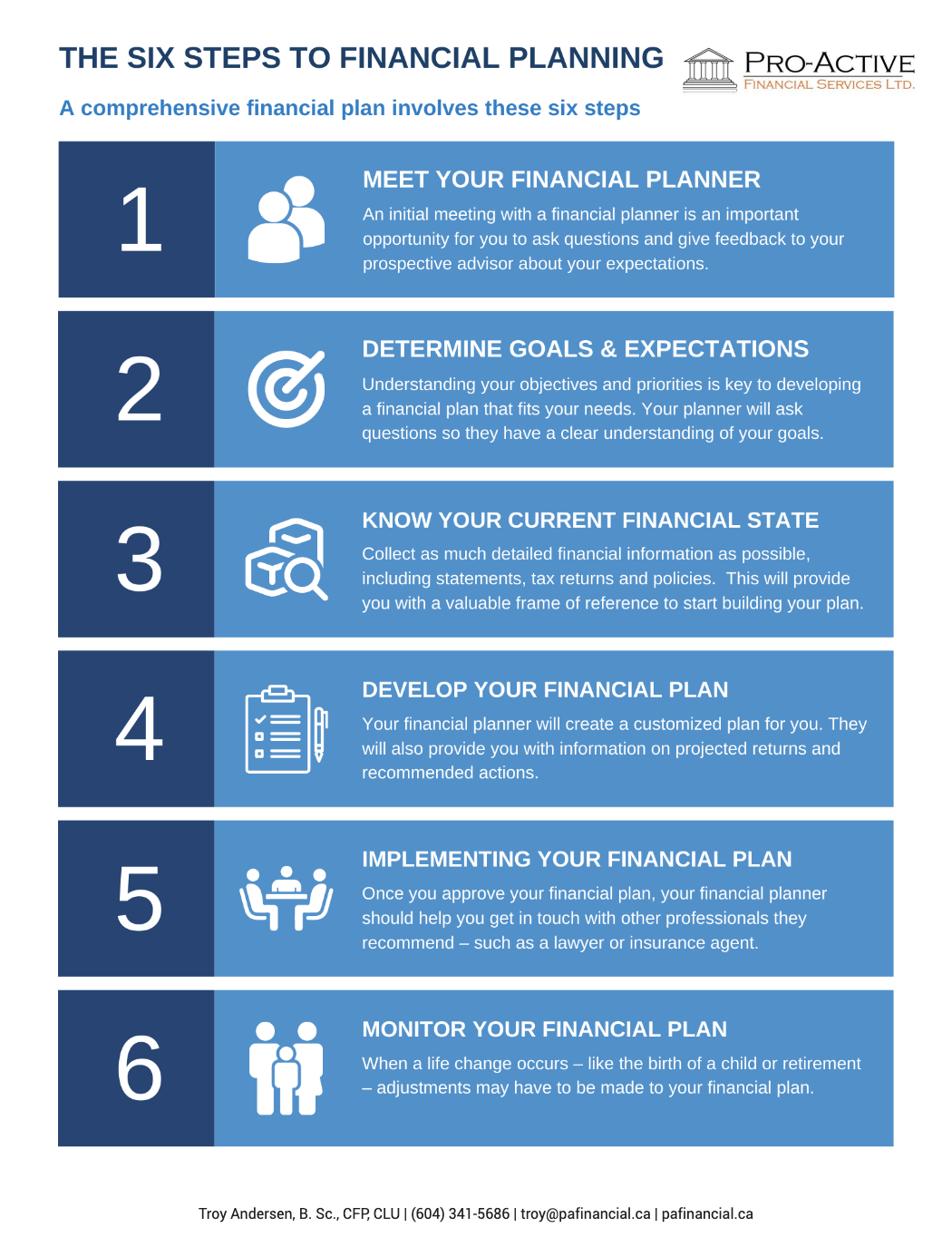
Many people put off planning for their financial future because they’re overwhelmed with all the decisions they have to make. The good news is that there’s help at hand – in the form of a certified financial planner. A certified financial planner is trained to focus on all aspects of your finances – everything from your taxes to retirement savings.

A certified financial planner will develop a plan that works for you both today and in the future.

Meeting your financial planner

When you first meet with your financial planner, they will tell you about their obligations and responsibilities. They should:

  • Give you a general overview of the financial planning process

  • Tell you what services they provide and how they are compensated for them

  • Let you know what they will expect from you as a client

You should let your financial planner know how involved you want to be in creating and executing your financial plan. You should also ask any questions about the process or how compensation works.

Determining your goals and expectations

Now you’re ready to make your plan. But first, you and your financial planner should discuss your personal and financial goals and your current and future needs and priorities.

Your financial planner will make sure they have all the details they need. They may ask you to fill in questionnaires or provide documentation on your current financial state.

Reviewing your current financial state

Before your financial planner can get started on your financial plan, they need to know about your current situation – including cash flow, net worth and any taxes you may owe in the future.

To customize your financial plan, so it works for you, your financial planner must know about anything that could impact it – for example, a dependent adult child.

Developing the financial plan

Once they have all the information they need, your financial planner will create a customized plan that aligns with your goals, objectives, and risk tolerance. They will also provide you with information on projected returns and recommended actions.

Implementing the plan

Once you approve it, your financial planner should implement your plan. They should also help you contact other professionals they’ve recommended to assist with your financial plan – such as a lawyer or an insurance agent.

Monitoring the plan

Your certified financial planner should periodically contact you to adjust your financial plan. In addition, a life change – such as the birth of a child or retirement – may require adjustments to your financial plan.

It can be hard to plan for the future – but you don’t have to do it alone. Contact a certified financial planner or us today!

Life Insurance after 60- is it necessary?

You may have had life insurance for as long as you can remember. You wanted to make sure that your family would be taken care of and be able to pay their bills if anything happened to you.

But now that you’re older and your children are grown – and hopefully your mortgage is paid off – you may not feel you still need life insurance. This could be a valid assumption; however, there are some circumstances under which it may still make sense for you to have life insurance. They are:

  • You still have substantial debt.

  • You have dependent children or grandchildren.

  • You want to leave a financial legacy.

You still have substantial debt

No one likes the thought of leaving their loved ones to pay their debts if they die. If, however, someone has co-signed a loan with you – for example, for a mortgage or a car – and you die, then they will be on the hook for the entire amount.

If you have life insurance and name your co-signer as the beneficiary, this will help relieve any financial burden your death could cause them.

You have dependent children or grandchildren

If you have children who are still dependent on you because they have a mental or physical disability, life insurance can be an excellent way to ensure they will still have access to funds after you die.  Lifelong care can be expensive, and a life insurance benefit will go a long way to helping fund it.

You may have grandchildren you are caring for or that you are not responsible for but want to leave money they can use towards higher
education.  A life insurance payout can be a great way to help a grandchild get a good start in life without having to go into debt.

You want to leave a financial legacy

You may not have dependent children or grandchildren but still want to leave them something when you die. Life insurance can be a great way to do this without cutting back on your spending during your lifetime.

Life insurance can also help make sure that you have something to leave everyone in your will. If you have a family cottage, it can
be complicated to leave it to more than one person or family. Life insurance gives you the option to leave one person or family the cottage and another person or family the cash equivalent.

We can help you!

If you’re unsure whether or not it still makes sense to have life insurance after the age of 60, we’d be happy to sit down with you and talk through your options. Give us a call or email us today!

DFS 2022 Federal Budget Highlights

Federal Budget 2022 – Highlights

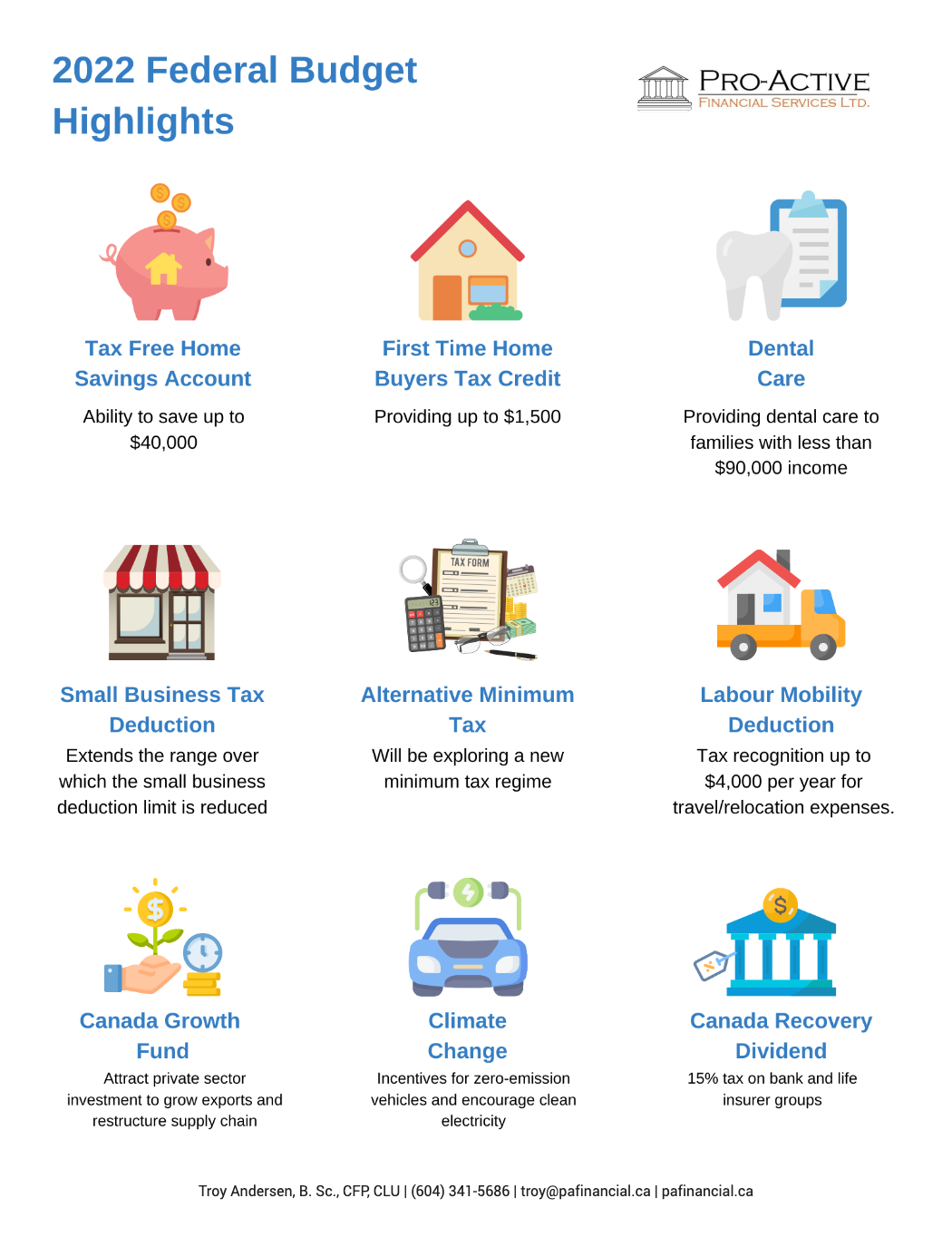
On April 7, 2022, the Federal Government released their 2022 budget. We have broken down the highlights of the financial measures in this budget into the following different sections:

  • Housing

  • Alternative minimum tax

  • Dental care

  • Small businesses

  • Tradespeople

  • Canada Growth Fund

  • Climate

  • Bank and insurer taxes

Housing

There were several tax measures related to housing introduced in the budget.

Budget 2022 introduced a new kind of savings account – a Tax-Free First Home Savings Account (FHSA).

These are the key things you need to know about the new FHSAs:

  • You must be at least 18 years of age and a resident of Canada to open an account. You must also not currently own a home or have owned one in the previous four calendar years.

  • You can only open and use an FHSA once, and you must close it within a year after your first withdrawal.

  • Contributions are tax-deductible, and income earned in an FHSA will not be taxed while it is in the account or when you withdraw it to purchase a house.

  • There is a lifetime contribution limit of $40,00, with an annual contribution limit of $8,000. You can’t carry contribution room forward.

  • If you don’t use the funds in your FHSA within 15 years of opening it, you can transfer them to an RRSP or RRIF tax-free. Transfers to an RRSP do not impact your RRSP contribution room.

Two existing tax credits were increased, and a new tax credit was introduced:

  • The First-Time Home Buyers’ Tax Credit amount was increased from $5000 to $10,000, giving up to $1,500 in direct support to home buyers. This tax credit applies to all homes purchased on or after January 1, 2022.

  • The annual expense limit for the Home Accessibility Tax Credit has been increased to $20,000 for 2022 and subsequent tax years.

  • A new tax credit, the Multigenerational Home Renovation Tax Credit, was introduced, which will start in 2023. This tax credit is a 15% refundable credit for eligible expenses up to $50,000 (maximum tax credit is $7,500) for constructing a secondary suite for a senior or an adult with a disability to live with a qualifying relative.

Budget 2022 proposes new rules, effective January 1, 2023, that anyone who sells a residential property they have held for less than 12 months would be subject to full taxation on their profits as business income. However, there will be some exemptions to these rules due to life events such as a death, disability, the birth of a child, a new job, or a divorce.

Budget 2022 also announces restrictions that would help ensure that Canadians, instead of foreign investors, own housing. A two-year ban will be introduced on non-residents buying residential property, with some exceptions, such as individuals who have work permits and are living in Canada.

Alternative Minimum Tax

In Canada, the top federal tax rate is 33% and starts at an income of $221,708. However, many high-income filers end up paying less tax than this due to tax deductions and tax credits.

The goal of the Alternative Minimum Tax (AMT), which has been around since 1986, is to ensure high-income Canadians are paying their fair share of taxes. However, it has not been substantially updated since it was introduced. In Budget 2022, the government indicated they would be investigating changes to the AMT, which will likely be disclosed in the fall 2022 economic update.

Dental Care

For many Canadians without private coverage, going to the dentist is too expensive. Budget 2022 commits $5.3 billion to provide dental care for Canadians with family incomes of less than $90,000 annually. Coverage will start for children under 12 this year and expand to children under 18, seniors and those living with a disability in 2023, with the program will be fully implemented by 2025.

Small Businesses

Small businesses currently have a 9% tax rate on the first $500,000 of taxable income (compared to the corporate tax rate of 15%). However, after a small business’ capital employed in Canada reaches $15 million, it is no longer eligible for the 9% tax rate.

Budget 2022 proposes gradually raising the small business tax rate cut-off so that businesses are not discouraged from expanding. The new cut-off for the lower tax rate will be $50 million.

Budget 2022 also includes a proposal to create an Employee Ownership Trust. This would be a new, dedicated trust under the Income Tax Act to support employee ownership.

Tradespeople

Budget 2022 introduces the Labour Mobility Deduction. This would allow eligible tradespersons and apprentices to deduct up to $4,000 a year in eligible travel and temporary relocation expenses.

Budget 2022 also commits to providing $84.2 million over four years to double funding for the Union Training and Innovation Program, which would help 3,500 apprentices from underrepresented groups each year.

Canada Growth Fund

Budget 2022 introduces a new Canada Growth Fund, with the goals of both diversifying our economy and helping achieve our climate goals.

The Canada Growth Fund aims to attract considerable private sector investment, support the restructuring of vital supply chains, and bolster our exports. The Canada Growth Fund will also provide backing to reduce our emissions and invest in the growth of low-carbon industries.

Climate

Budget 2022 continues to confirm the government’s commitment to fighting climate change. It commits $1.7 billion over five years to extend the Incentives for Zero-Emission Vehicles Program until March 2025 and also provides funding to create a national network of electric vehicle charging stations.

Budget 2022 also commits $250 million over four years to support the development of clean electricity, including inter-provincial electricity transmission projects and Small Modular Reactors.

Bank And Insurer Taxes

Budget 2022 introduced a new financial measure called the Canada Recovery Dividend. Banks and insurers will have to pay a one-time, 15% tax on 2021 taxable income above $1 billion. This tax will be payable over five years.

Budget 2022 also proposes increasing the tax rate on income above $100 million for banks and insurers to 16.5% (currently 15% for other corporations).

Wondering How This May Impact You?

If you have any questions or concerns about how the new federal budget may impact you, call us – we’d be happy to help you!

2022 Federal Budget Highlights

Federal Budget 2022 – Highlights

On April 7, 2022, the Federal Government released their 2022 budget. We have broken down the highlights of the financial measures in this budget into the following different sections:

  • Housing

  • Alternative minimum tax

  • Dental care

  • Small businesses

  • Tradespeople

  • Canada Growth Fund

  • Climate

  • Bank and insurer taxes

Housing

There were several tax measures related to housing introduced in the budget.

Budget 2022 introduced a new kind of savings account – a Tax-Free First Home Savings Account (FHSA).

These are the key things you need to know about the new FHSAs:

  • You must be at least 18 years of age and a resident of Canada to open an account. You must also not currently own a home or have owned one in the previous four calendar years.

  • You can only open and use an FHSA once, and you must close it within a year after your first withdrawal.

  • Contributions are tax-deductible, and income earned in an FHSA will not be either while it is in the account or when you withdraw it.

  • There is a lifetime contribution limit of $40,00, with an annual contribution limit of $8,000. You can’t carry contribution room forward.

  • If you don’t use the funds in your FHSA within 15 years of opening it, you can transfer them to an RRSP or RRIF tax-free. Transfers to an RRSP do not impact your RRSP contribution room.

Two existing tax credits were increased, and a new one was introduced:

  • The First-Time Home Buyers’ Tax Credit amount was increased from $5000 to $10,000, giving up to $1,500 in direct support to home buyers. This tax credit applies to all homes purchased on or after January 1, 2022.

  • The annual expense limit for the Home Accessibility Tax Credit has been increased to $20,000 for 2022 and subsequent tax years.

  • A new tax credit, the Multigenerational Home Renovation Tax Credit, was introduced, which will start in 2023. This tax credit is a 15% refundable credit for eligible expenses up to $50,000 (maximum tax credit is $7,500) for constructing a secondary suite for a senior or an adult with a disability to live with a qualifying relative.

Budget 2022 proposes new rules, effective January 1, 2023, that anyone who sells a residential property they have held for less than 12 months would be subject to full taxation on their profits as business income. However, there will be some exemptions to these rules due to life events such as a death, disability, the birth of a child, a new job, or a divorce.

Budget 2022 also announces restrictions that would help ensure that Canadians, instead of foreign investors, own housing. A two-year ban will be introduced on non-residents buying residential property, with some exceptions, such as individuals who have work permits and are living in Canada.

Alternative Minimum Tax

In Canada, the top federal tax rate is 33% and starts at an income of $221,708. However, many high-income filers end up paying less tax than this due to tax deductions and tax credits.

The goal of the Alternative Minimum Tax (AMT), which has been around since 1986, is to ensure high-income Canadians are paying their fair share of taxes. However, it has not been substantially updated since it was introduced. In Budget 2022, the government indicated they would be investigating changes to the AMT, which will likely be disclosed in the fall 2022 economic update.

Dental Care

For many Canadians without private coverage, going to the dentist is too expensive. Budget 2022 commits $5.3 billion to provide dental care for Canadians with family incomes of less than $90,000 annually. Coverage will start for children under 12 this year and expand to children under 18, seniors and those living with a disability in 2023, with the program will be fully implemented by 2025.

Small Businesses

Small businesses currently have a 9% tax rate on the first $500,000 of taxable income (compared to the corporate tax rate of 15%). However, after a small business’ capital employed in Canada reaches $15 million, it is no longer eligible for the 9% tax rate.

Budget 2022 proposes gradually phasing out the small business tax rate so that businesses are not discouraged from expanding. The new cut-off for the lower tax rate will be $50 million.

Budget 2022 also includes a proposal to create an Employee Ownership Trust. This would be a new, dedicated trust under the Income Tax Act to support employee ownership.

Tradespeople

Budget 2022 introduces the Labour Mobility Deduction. This would allow eligible tradespersons and apprentices to deduct up to $4,000 a year in eligible travel and temporary relocation expenses.

Budget 2022 also commits to providing $84.2 million over four years to double funding for the Union Training and Innovation Program, which would help 3,500 apprentices from underrepresented groups each year.

Canada Growth Fund

Budget 2022 introduces a new Canada Growth Fund, with the goals of both diversifying our economy and helping achieve our climate goals.

The Canada Growth Fund aims to attract considerable private sector investment, support the restructuring of vital supply chains, and bolster our exports. The Canada Growth Fund will also provide backing to reduce our emissions and invest in the growth of low-carbon industries.

Climate

Budget 2022 continues to confirm the government’s commitment to fighting climate change. It commits $1.7 billion over five years to extend the Incentives for Zero-Emission Vehicles Program until March 2025 and also provides funding to create a national network of electric vehicle charging stations.

Budget 2022 also commits $250 million over four years to support the development of clean electricity, including inter-provincial electricity transmission projects and Small Modular Reactors.

Bank And Insurer Taxes

Budget 2022 introduced a new financial measure called the Canada Recovery Dividend. Banks and insurers will have to pay a one-time, 15% tax on 2021 taxable income above $1 billion. This tax will be payable over five years.

Budget 2022 also proposes increasing the tax rate on income above $100 million for banks and insurers to 16.5% (currently 15% for other corporations).

Wondering How This May Impact You?

If you have any questions or concerns about how the new federal budget may impact you, call us – we’d be happy to help you!

Group Retirement Benefits

Working at an organization that offers a pension plan is one of the greatest financial advantages a Canadian can enjoy. Pension plans are designed to provide retirement income and help employees reach their retirement goals and for business owners- help retain key employees.

Pension plans can offer:

  • Employer contributions

  • Forced retirement savings for employee

There are 2 main types of pension plan:

  • Defined Benefit Plan

  • Defined Contribution Plan

Defined Benefit Plan

  • Retirement income is guaranteed, contributions are not.

  • The pension amount is based on a formula that includes the employee’s earnings and years of service with the employer

  • Usually, contributions are made by the employee and employer

  • The employer is responsible for investing the contributions to ensure there’s enough money to pay the future pensions for all plan members.

  • If there’s a shortfall, the employer pays the difference.

Defined Contribution Plan

  • Contributions are guaranteed, retirement income is not.

  • Usually, contributions are made by the employee and employer.

  • The employee is responsible for investing all contributions.

  • The amount available in retirement depends on how the investment performs including total contributions.

  • At retirement, the money in the account can be used to generate retirement income through purchasing an annuity or transferring the amount to a locked-in retirement income fund.

In summary, a defined benefits plan guarantees you a retirement income and a defined contribution plan guarantees contributions but not retirement income.

Talk to us, we can help.